
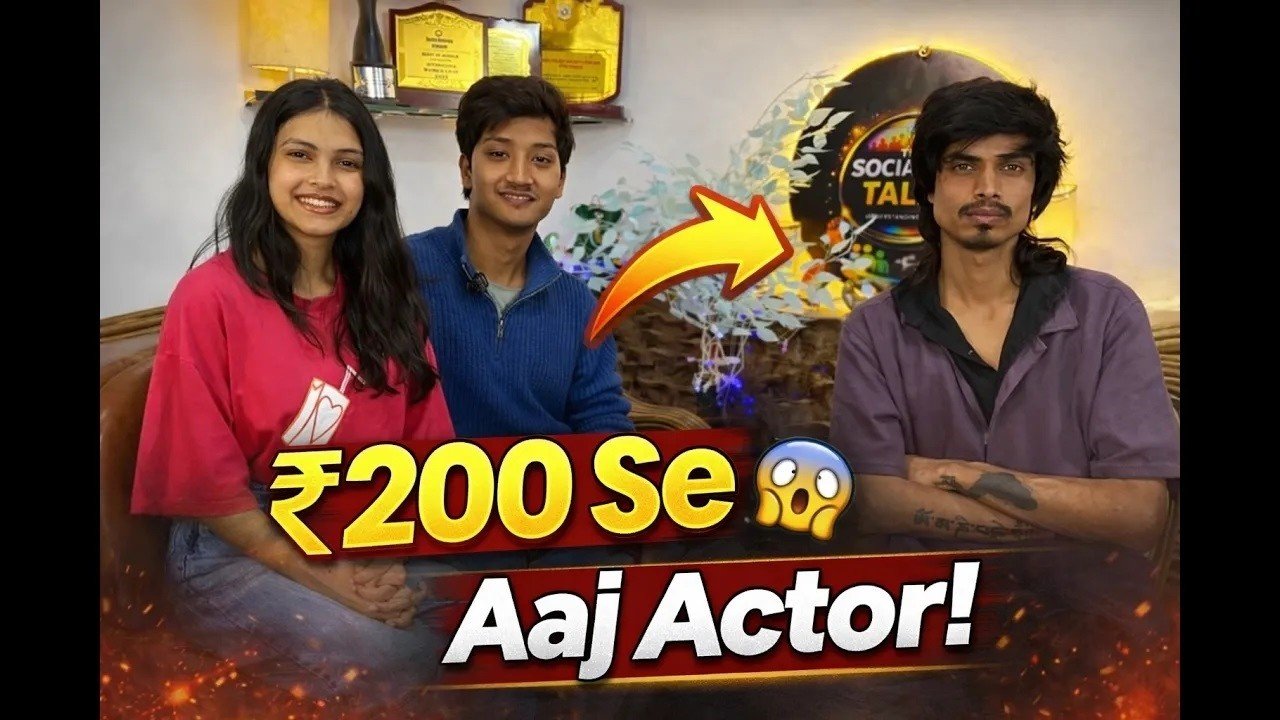
Arjun Thapa & Anamika Raj Podcast | Acting Dreams, Rejections, Gen Z, Bollywood Struggles & Modern Relationships
Some Conversations Feel Like Two Young Dreams Talking To Each Other
There are podcasts where guests arrive prepared.
Prepared answers.
Prepared stories.
Prepared personalities.
And then there are conversations like this one.
Messy. Honest. Funny. Emotional. Unfiltered.
The episode featuring Arjun Thapa and Anamika Raj on The Socialens Talks does not feel like a formal interview.
It feels like sitting with two young artists who are still figuring life out while chasing impossible dreams.
Throughout the conversation:
- they joke constantly
- talk openly about rejection
- discuss acting struggles
- social media pressure
- family expectations
- Bollywood fantasies
- financial realities
- auditions
- insecurity
- loneliness
- and the emotional chaos of trying to become “someone” before society loses patience with you
And perhaps that is exactly why this podcast feels relatable.
Because unlike polished celebrity interviews,
this conversation still carries uncertainty.
And uncertainty is what makes it real.
Dehradun Is Not Just A City For Them
Very early in the conversation, both Arjun and Anamika speak emotionally about Dehradun and Uttarakhand.
For Arjun, Mumbai may represent work.
But Uttarakhand represents peace.
He explains that no matter where career takes him,
the emotional calm of mountains still feels like home.
That statement quietly reflects something many creative people from smaller cities experience.
Big cities may offer opportunities.
But emotional belonging often stays attached to home.
Anamika shares similar feelings.
Even though she dreams of cinema and acting,
she still proudly says:
“I feel really proud that I was born in Dehradun.”
That emotional grounding becomes important throughout the episode.
Because despite discussing fame, films, and ambition,
both guests remain deeply connected to where they came from.
Arjun’s Acting Journey Started Because Of CID
One of the funniest and most wholesome stories in the podcast comes when Arjun explains how he accidentally entered acting.
As a child, he loved CID.
Especially Daya sir.
In fact, he was so obsessed that he only visited the shooting location because he wanted to see how Daya broke doors.
That innocent curiosity unexpectedly changed his life.
According to him:
a child actor failed to arrive for the shoot,
and somehow he randomly ended up standing near Daya sir.
The director noticed him and gave him a tiny featured role.
No big dialogues.
Just a small interaction.
But for a child,
seeing himself on television changed everything.
And honestly, this section perfectly captures how careers sometimes begin accidentally.
Not through planning.
But through fascination.
“Call Me Raj…”
Perhaps the most adorable moment comes when Arjun explains how deeply Shah Rukh Khan and DDLJ affected him during childhood.
After watching Dilwale Dulhania Le Jayenge,
he became obsessed with the “Raj” personality.
He even stopped responding when people called him Arjun.
He wanted everyone to call him “Raj.”
Leather jacket fantasies.
NRI hero energy.
Romantic dialogues.
Bollywood imagination.
That section feels extremely relatable because almost every Indian child has experienced cinema influencing identity at some level.
And honestly, conversations around identity and self-image also connect beautifully with themes explored in Aditi Sharma Podcast, where personal identity becomes an emotional core of survival itself.
Dance Came Before Acting
Before acting seriously,
Arjun spent nearly eight years professionally learning dance.
He trained under Ashish Bhatia and participated in:
- competitions
- performances
- and dance-based projects
At one point,
he genuinely believed dance would become his primary career.
But slowly acting started replacing that dream.
And what becomes interesting is how honestly he speaks about changing ambitions.
There is no fake “I always knew my destiny” energy.
Instead,
he openly admits childhood dreams constantly changed.
And that honesty makes the conversation human.
Anamika’s Dream Started From Fantasy TV Shows
For Anamika Raj,
the spark began through fantasy television.
She remembers watching fantasy-based children’s shows and imagining herself inside those magical worlds.
At first it was childish fascination.
But over time,
that fascination became ambition.
Eventually she entered theatre during school and performed in stage productions connected to India’s independence movement.
And from there,
acting slowly stopped feeling like fantasy.
It became a career possibility.
“When Success Starts Showing, Society Changes”
One important discussion in the podcast revolves around family support.
Anamika openly admits that initially,
her family wanted her to become a doctor.
Acting did not feel like a “safe” profession.
And honestly,
this reflects the reality of countless Indian households.
Creative careers are often treated as risky until success becomes visible.
According to her:
once projects started happening,
mindsets slowly changed.
That line quietly explains how Indian families often trust results more than dreams.
The Reality Of First Payments
One of the funniest parts of the episode comes when they discuss first payments.
Arjun recalls earning:
₹200 as a junior artist.
Standing in long payment lines after exhausting shoots.
Feeling less like an “actor”
and more like a labor worker waiting for daily wages.
Meanwhile,
Anamika talks about earning ₹5000 during an early project and how meaningful even small amounts felt initially.
That section becomes surprisingly emotional.
Because creative careers often look glamorous from outside.
But behind every successful actor exists:
- unpaid work
- tiny payments
- exhausting shoots
- and years of invisible struggle.
“Actors Must Learn Everything”
Arjun repeatedly says something very important throughout the conversation:
Actors should learn multiple skills.
Not necessarily to become experts.
But to become believable.
He explains:
if tomorrow he has to play:
- a singer
- swimmer
- guitarist
- or athlete
basic familiarity helps performance feel authentic.
That perspective reflects genuine dedication toward craft rather than fame alone.
And honestly,
that obsessive learning mindset also connects with themes discussed in Prince Divas Dabral Podcast, where creative survival requires constant self-improvement.
Gen Z Is Different — And They Know It
One surprisingly thoughtful section focuses on Gen Z culture.
Both guests discuss how today’s generation grows up differently compared to earlier generations.
According to Arjun:
today’s children understand:
- cameras
- social media
- internet trends
- online language
- and digital culture
much earlier than older generations ever did.
He does not say this judgmentally.
Instead,
he simply accepts that modern youth grow up much faster emotionally and digitally.
That observation quietly becomes one of the smartest social discussions in the episode.
Rejection Slowly Changes People
One of the strongest emotional sections begins when Arjun starts discussing Mumbai auditions.
And suddenly,
the energy of the podcast changes.
The joking disappears.
Reality enters.
He describes:
- standing in audition lines at 2 AM
- getting rejected repeatedly
- feeling emotionally exhausted
- staying hungry during auditions
- and slowly losing confidence
According to him:
Mumbai tests people emotionally before rewarding them.
And honestly,
this part may be one of the most brutally honest sections in the entire episode.
Because rejection is rarely shown honestly online.
Social media only shows:
- success posts
- film announcements
- smiling reels
- behind-the-scenes glamour
Nobody uploads emotional breakdowns after failed auditions.
“Every Night I Feel Like Quitting”
Both guests openly admit something extremely relatable:
They regularly feel like quitting.
Anamika says:
sometimes after failed auditions or disappointing meetings,
she questions whether continuing even makes sense.
Arjun also admits:
there were phases where he stopped doing everything.
No motivation.
No energy.
No direction.
Just sitting silently at home.
That emotional honesty becomes powerful because modern social media culture constantly pressures young people to appear motivated 24/7.
But reality looks very different.
And honestly,
these mental health struggles also emotionally connect with conversations explored in Sunny Dayal Podcast, where emotional confusion and modern pressure are discussed deeply.
Bollywood Vs OTT
Another interesting discussion revolves around OTT and Bollywood.
Anamika believes OTT platforms represent the future because audiences now prefer realistic storytelling.
But Arjun still emotionally chooses Bollywood.
Why?
Because for him,
Bollywood still represents cinematic magic.
Large screens.
Slow-motion hero shots.
Romantic storytelling.
Larger-than-life emotion.
That contrast between realism and fantasy becomes fascinating.
Because both perspectives are correct in different ways.
Their Upcoming Projects & Music Video
The episode also explores upcoming work.
Anamika discusses a theatre performance based on Mahabharata where a single actor performs multiple characters.
Meanwhile,
Arjun reveals:
- upcoming films
- web projects
- and a romantic music video called “Dil Deewana Tera”
The chemistry between both guests during these discussions feels extremely natural.
Nothing feels overly promotional.
Instead,
it feels like two young artists genuinely excited about opportunities they worked hard for.
Social Media Fame Is Misunderstood
One powerful section discusses how outsiders view actors and influencers.
According to both guests:
people assume creative careers are easy because they only see finished content online.
But they rarely see:
- sleepless shoots
- 24-hour schedules
- physical exhaustion
- repeated retakes
- emotional burnout
- and constant pressure to stay visible online.
Arjun specifically says:
“People think anyone can act.”
That line quietly captures the frustration many artists feel.
Because entertainment looks effortless only when the performer hides the struggle successfully.
Anamika’s Worst Industry Experience
One emotionally serious moment comes when Anamika discusses a deeply uncomfortable experience during a music video shoot.
She avoids sensationalizing it.
But she openly admits:
the glamorous entertainment world also contains darker realities.
She says:
the experience shocked her so much that she temporarily stopped accepting projects afterward.
That moment becomes important because it reflects the vulnerability many young newcomers experience inside creative industries.
Especially women.
And honestly,
this conversation around emotional safety also connects strongly with themes explored in Soniya Sharma Podcast, where women discuss navigating unsafe environments while building careers.
“Success Silences Society”
One of the strongest lines from Anamika comes when she says:
“When success starts showing, everyone becomes silent.”
That sentence captures a painful social truth.
People often:
- doubt dreams initially
- criticize unconventional careers
- question ambition
- and judge risk-taking
But once success becomes visible,
the same society changes tone completely.
“Arjun Thapa Is A Learner”
Toward the end of the episode,
the host asks both guests an interesting question:
“Who are you?”
Anamika confidently replies:
“Anamika Raj is a successful actor.”
Meanwhile Arjun answers differently.
He says:
“Arjun Thapa is a learner.”
That response quietly becomes one of the most mature moments in the entire podcast.
Because despite confidence,
he still sees himself as someone evolving daily.
If Social Media Disappeared Tomorrow…
One thoughtful section explores identity beyond social media.
The host asks:
“What if Instagram, YouTube, and social media disappear tomorrow?”
Both guests answer beautifully.
Anamika says:
her skill would still remain.
Arjun says:
he would continue performing through theatre and street plays even without social media.
That answer reveals something important:
Real artists eventually perform because they love expression itself.
Not only because cameras exist.
The Industry Is Slowly Opening Up
One mature observation from Arjun revolves around outsiders entering the industry.
According to him:
things are improving slowly.
Earlier,
opportunities for outsiders felt far more limited.
But today:
digital platforms,
auditions,
and social media visibility have opened new doors.
However,
he also admits struggle remains unavoidable.
Key Takeaways
- Creative careers involve emotional uncertainty.
- Rejection is a normal part of artistic growth.
- Social media rarely shows real struggles behind success.
- Family support often increases only after visible success.
- Modern Gen Z culture is shaping artists differently.
- Acting requires learning multiple life skills.
- Bollywood and OTT represent two different storytelling worlds.
- Mental burnout is common inside creative industries.
- Real artists continue creating even without fame.
- Persistence matters more than temporary motivation.
FAQ
Who are Arjun Thapa and Anamika Raj?
Arjun Thapa and Anamika Raj are young actors and performers from Uttarakhand featured on The Socialens Talks podcast discussing acting struggles, Bollywood dreams, auditions, and social media culture.
What is discussed in the Arjun Thapa & Anamika Raj Podcast?
The podcast discusses acting journeys, auditions, rejection, Gen Z culture, Bollywood, OTT platforms, mental pressure, and life inside the entertainment industry.
Did Arjun Thapa work as a junior artist?
Yes. Arjun openly discusses working as a junior artist during early career struggles and explains the exhausting realities behind shoots and payments.
What upcoming projects were mentioned?
The guests discussed theatre performances, upcoming films, OTT work, and a romantic music video called “Dil Deewana Tera.”
What message did they give young artists?
Both encouraged young people to believe in themselves, face rejection bravely, and continue improving instead of quitting after failures.
Related Podcasts From The Socialens Talks
If you enjoyed this conversation, you may also like:
- Aditi Sharma Podcast
- Prince Divas Dabral Podcast
- Sunny Dayal Podcast
- Soniya Sharma Podcast
- Luchacha Veer Podcast
Conclusion
The most beautiful thing about this podcast is that neither Arjun nor Anamika pretend to have life fully figured out.
They are still learning.
Still struggling.
Still getting rejected.
Still chasing uncertain dreams.
And maybe that honesty is exactly what makes this conversation emotionally powerful.
Because in today’s internet culture,
people often fake confidence before achieving anything.
But this podcast captures something rarer:
Young artists honestly admitting fear while continuing forward anyway.
And perhaps that is real courage.