
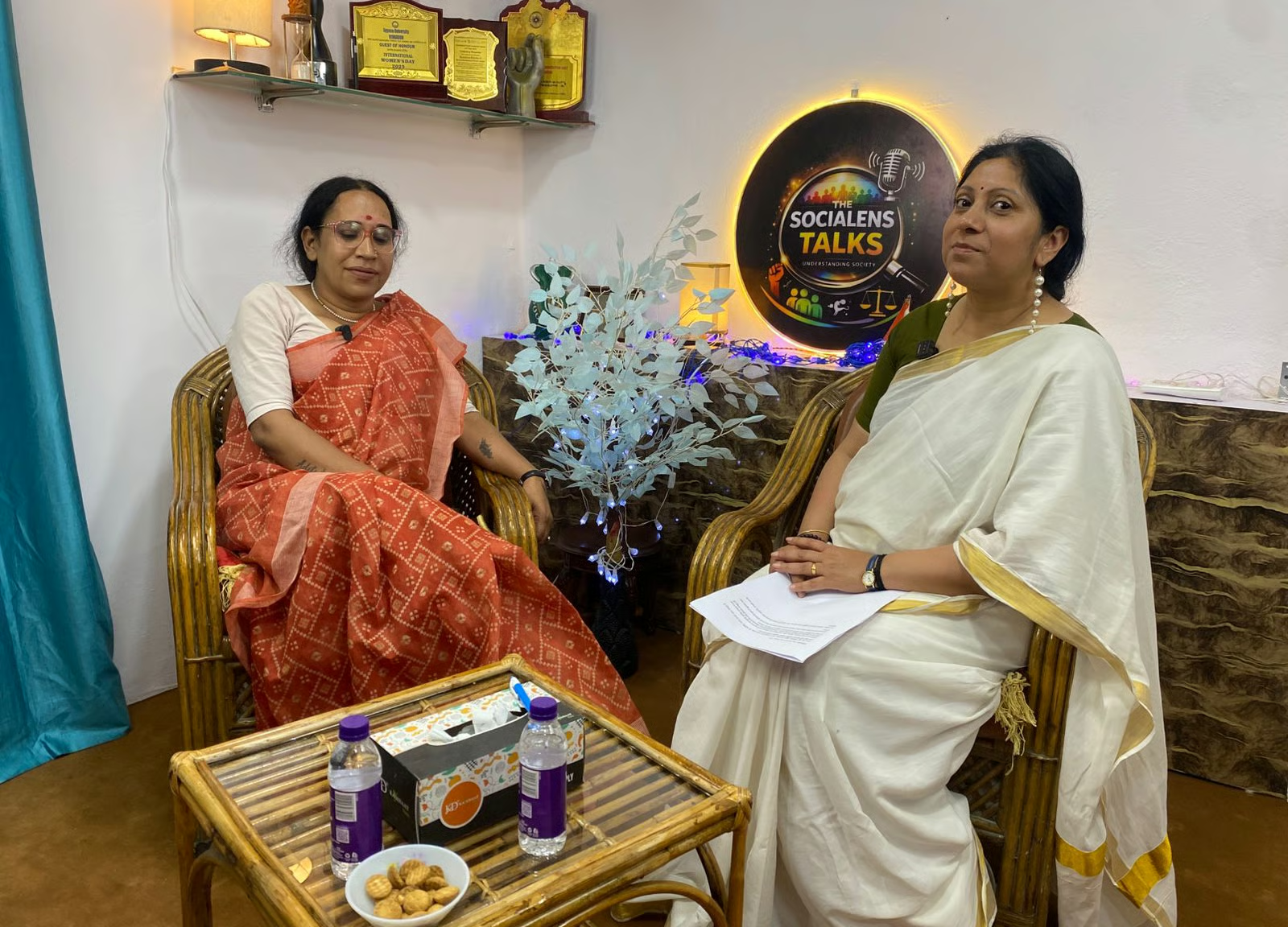
A Conversation About Identity, Survival, Acceptance and Finding a Way Forward
Some conversations are difficult because the subject itself is difficult.
The conversation with Aditi Sharma on The Socialens Talks is one of them.
Aditi speaks openly about growing up with an identity that people around her did not understand, leaving home at a young age, facing rejection and discrimination, working to survive, entering traditional transgender community structures, and eventually building an independent life through entrepreneurship and social work.
But this is not only a story about hardship.
It is also a conversation about work, dignity, self-reliance, family, entrepreneurship, acceptance and the hope that the next generation should have a different experience.
One of the strongest ideas running through the conversation is simple:
Transgender people can also work, build businesses and become financially independent.
Aditi’s journey gives that statement a very personal meaning.
“We Can Earn With Hard Work Too”
Early in the conversation, Aditi challenges a common stereotype about transgender people.
She talks about how society often associates transgender communities primarily with traditional forms of earning such as begging, ceremonial money collection and other community-based practices.
Her response is straightforward:
“We can earn with hard work too.”
For Aditi, this is not simply a statement about employment.
It is about having the opportunity to choose one’s own way of living.
Her own journey eventually took her toward employment, learning different skills, trying a boutique and later establishing her own food business.
That experience became important to the way she thinks about dignity.
For her, independence is not about proving something to society.
It is about having the ability to earn through one’s own effort.
Realising She Was Different During Childhood
Aditi describes understanding from a young age that she was different from what people around her expected.
She recalls this awareness developing during childhood, around the age of seven or eight and continuing as she grew older.
As her behaviour and feelings became more visible, people around her also began noticing the difference.
She grew up in Uttarkashi, Uttarakhand, where the close-knit nature of a small community meant that personal matters could quickly become known to others.
For a child trying to understand their own identity, that environment could become extremely difficult.
Instead of having the freedom to simply grow up and discover herself, Aditi had to deal with questions, judgement and social expectations at a very young age.
Leaving Home at 17–18
One of the most significant parts of Aditi’s story is that she left home around the age of 17–18.
She explains that people around her did not understand her identity and that continuing to live in that environment became increasingly difficult.
Leaving home at that age meant that she had to learn how to survive independently much earlier than many young people.
There was no simple transition from school to college or from college to a conventional career.
Instead, survival itself became part of her education.
That experience remained an important part of the person she eventually became.
“The Aditi You See Today Was Not Always Like This”
During the conversation, Aditi reflects on how different her life was earlier.
The confident person sitting in front of the camera today was shaped by years of uncertainty.
There were periods of:
- loneliness
- rejection
- financial difficulty
- social discrimination
- uncertainty about the future
- and emotional distress.
Her present-day confidence therefore did not appear overnight.
It developed through experience.
That distinction is important because people often see someone’s present situation without knowing the years of struggle that came before it.
Survival Before Independence
After leaving home, Aditi had to find ways to support herself.
She describes working in people’s homes and doing domestic work such as cleaning and washing utensils.
At the same time, she continued trying to learn and improve her situation.
She later opened a boutique.
However, even while trying to establish herself through work, she faced inappropriate behaviour and harassment.
These experiences contributed to the difficult choices she eventually had to make.
For Aditi, entering traditional transgender community structures was connected to survival.
Her story therefore complicates the assumption that people enter such systems simply because they prefer them.
Her experience shows how limited opportunities can influence the choices available to someone.
“When Every Door Closes…”
A particularly meaningful idea in Aditi’s story is the feeling that when conventional opportunities repeatedly close, people are eventually pushed toward whatever form of support remains available.
For her, traditional community structures became part of that survival journey.
But she did not want that to remain the only possible path.
She wanted to create another option for herself.
That desire eventually became connected to entrepreneurship.
The Moment That Changed Her Thinking About Earning
Aditi recalls an experience involving a financially struggling family.
During one of the traditional community-related occasions, she received money from a family that appeared to have collected it with difficulty.
The experience made her uncomfortable.
She began thinking about whether she wanted her livelihood to depend on people who themselves were struggling financially.
That moment contributed to a decision:
She wanted to earn independently through her own work.
It was an important turning point.
Instead of asking only how she could survive, she began thinking about how she could build something of her own.
From Survival to Entrepreneurship
Aditi eventually moved toward entrepreneurship.
Her journey included establishing a food business in Dehradun, which became known as “Nivala Pyaar Ka.”
The name itself carries meaning.
Aditi explains that transgender people can sometimes encounter fear or rejection even before they have spoken to someone.
People may shut doors simply because of their appearance or identity.
She wanted her business to communicate something different.
The idea behind the name represents warmth, acceptance and human connection.
A restaurant therefore became more than a source of income.
It became part of her effort to create an independent identity.
Building a Business Was Not Easy
The entrepreneurial journey was not straightforward.
Aditi describes difficulties while trying to obtain financial support for her business.
She speaks about taking a substantial loan and facing questions and rejection while trying to establish the business.
She also describes situations where existing systems did not seem prepared to accommodate transgender applicants properly.
Even something as basic as forms and documentation could create difficulties when systems were designed around limited gender categories.
These experiences highlight a broader issue for entrepreneurs:
Access to opportunity is affected not only by individual ability, but also by whether institutions are prepared to support different kinds of people.
Entrepreneurship as a Path to Dignity
For Aditi, running a business has a meaning beyond earning money.
It gives her independence.
It allows her to interact with customers as a business owner.
It creates work.
And it gives her an opportunity to demonstrate that transgender people can participate in ordinary economic and professional life.
This is one of the most practical messages from the conversation.
Social acceptance cannot come only through speeches.
Economic participation also matters.
When people are able to study, work, run businesses and build careers, their relationship with society can change.
Why She Chose the Name “Aditi”
The story behind Aditi’s name is another personal detail from the conversation.
She explains that her childhood name was Sunil, while people close to her used to call her Adi.
Over time, she adopted the name Aditi.
For her, the name became part of the identity she chose for herself.
A name can appear like a small detail from the outside.
But for someone rebuilding their life around an identity that society previously misunderstood, choosing how they want to be addressed can carry considerable emotional significance.
The Reality of Discrimination
Aditi explains that discrimination does not necessarily disappear simply because someone becomes successful.
Even after gaining recognition and becoming involved in entrepreneurship and social work, she says she has continued to experience uncomfortable and discriminatory situations.
She recounts an incident at a public event where she was invited but did not feel properly included when it came time for her to speak.
The experience was deeply upsetting for her.
This raises an important distinction between inviting someone into a space and genuinely including them in that space.
Representation becomes meaningful only when the person is actually given respect and participation.
Why Future Generations Matter to Her
Aditi’s thinking gradually moves beyond her own experience.
She repeatedly expresses the hope that future transgender children should not have to experience the same level of rejection and hardship.
For her, change needs to begin much earlier.
Children need:
- family support
- education
- safety
- appropriate guidance
- emotional understanding
- and access to opportunities.
If those foundations are missing, young people can become vulnerable to exploitation and unsafe environments.
This is why Aditi speaks about support systems and shelter facilities for transgender youth.
The Need for Support Systems for Transgender Youth
Aditi talks about the importance of safe spaces where transgender children and young people can receive support.
She refers to models such as Garima Griha and discusses the need for shelter, education and rehabilitation support.
The larger point is that a young person who is rejected by their family should not be left with nowhere to go.
A safe support system can provide an alternative to homelessness, exploitation or unsafe survival situations.
For Aditi, such systems are particularly important because she understands from personal experience what it means to be without adequate family support.
A Story About a Transgender Child
One of the most serious portions of the conversation involves Aditi’s account of a transgender child who approached her for help after leaving home.
She describes the child facing severe reactions from people in the surrounding community, including forced changes to appearance and threats of violence.
The story is disturbing because it demonstrates how vulnerable transgender children can become when adults around them respond with punishment rather than understanding.
Aditi’s response is focused on protection.
Her message is that children should not be treated as if their identity is something that needs to be punished or eliminated.
Women in Uttarakhand and Silent Responsibilities
The conversation also moves beyond transgender issues.
Aditi talks about women in the mountain regions of Uttarakhand and the responsibilities many women carry within families.
She reflects on:
- household responsibilities
- geographical difficulties
- limited opportunities
- social expectations
- and the sacrifices women can make for their families.
Her own experiences appear to have increased her understanding of these struggles.
As she became more involved in social work, she says she began seeing the difficulties faced by women from another perspective.
This part of the conversation shows how personal experiences can broaden into empathy for other communities.
Harassment in Professional Life
Aditi also talks about inappropriate behaviour she encountered while trying to work independently.
Her experience at the boutique, for example, involved situations where customers’ husbands behaved inappropriately toward her.
Such experiences demonstrate another barrier that can affect people trying to establish themselves professionally.
For Aditi, earning independently did not mean discrimination suddenly disappeared.
It meant that she had to continue navigating it while building her own career.
Healthcare Experiences and Lack of Awareness
Another difficult subject discussed in the podcast is healthcare.
Aditi speaks about her experience around gender-related surgery and describes situations in which she felt humiliated or insufficiently respected.
She also raises concerns about a lack of awareness among some healthcare professionals regarding transgender patients.
The issue is particularly significant because healthcare is an area where people should be able to expect privacy and dignity.
Her experience highlights why awareness and sensitivity in healthcare settings matter.
Emotional Distress and Reaching a Breaking Point
Aditi also speaks openly about a period in her life when emotional pain became overwhelming and she attempted suicide.
She describes a period in which multiple forms of loss and rejection had accumulated:
- separation from home
- social rejection
- financial uncertainty
- lack of opportunities
- and intense loneliness.
She survived that period.
Today, she speaks about those experiences in the context of helping others and encouraging people to seek a different path.
This part of her story should not be reduced to a motivational slogan.
It represents how serious prolonged isolation and rejection can become for a person.
From Personal Pain to Social Work
One of the most significant changes in Aditi’s journey is the shift from surviving her own circumstances to trying to help others.
Her experiences have made her particularly concerned about transgender children and young people.
She wants future generations to have access to:
- education
- shelter
- employment
- entrepreneurship
- healthcare
- and family acceptance.
In this sense, her social work is closely connected to her personal history.
She is not discussing these issues as an outside observer.
She has experienced many of the barriers she talks about herself.
Society Is Changing — But Slowly
Aditi does not present the situation as completely hopeless.
She acknowledges that changes are taking place.
She points to increasing awareness and examples of transgender people receiving opportunities in areas where they were previously less visible.
There is also greater public discussion around transgender rights, employment and representation.
At the same time, she believes that significant gaps remain.
For her, visibility is only one stage.
The larger goal is normalisation—where transgender people can participate in education, employment, business and public life without being treated as unusual simply because of their identity.
The Importance of Family Acceptance
A recurring theme in Aditi’s story is family.
Society can influence a person’s life, but family acceptance can have an especially strong impact during childhood.
A transgender child who has support at home may have a very different experience from a child who is rejected.
That is why Aditi’s message is not limited to government policy or social institutions.
It begins at home.
Understanding.
Listening.
Supporting.
And allowing a child to grow without turning identity into a reason for punishment or abandonment.
“We Are Your Children Too”
Toward the end of the conversation, Aditi expresses one of her strongest messages:
“Transgender children are not downloaded from somewhere else. We are your children too.”
That sentence captures a major theme of the episode.
The discussion is not simply about labels.
It is about relationships.
A transgender child is still someone’s child.
They still need:
- love
- protection
- education
- guidance
- opportunity
- and dignity.
For Aditi, acceptance begins when families stop seeing transgender identity as a reason to separate themselves from their children.
What Aditi Sharma’s Journey Tells Us
Aditi’s story contains several different dimensions.
1. Identity and dignity are closely connected
Being allowed to live according to one’s identity is closely connected with personal dignity and emotional wellbeing.
2. Economic independence matters
Aditi’s journey from survival-based work to entrepreneurship demonstrates why access to employment and business opportunities matters.
3. Family support can change a child’s experience
Acceptance at home can provide security during a period when a young person is already trying to understand themselves.
4. Support systems are important
Young people who face family rejection need safe alternatives rather than being left without support.
5. Inclusion needs to be practical
Inviting someone to an event or publicly expressing support is different from actually giving them equal participation.
6. Social change takes time
Aditi recognises positive changes while also pointing to areas where discrimination continues.
7. Personal experience can become social purpose
Her own experiences have influenced her desire to help other transgender people, particularly younger generations.
Why This Conversation Matters
The Aditi Sharma episode is important because it moves beyond abstract discussions about transgender identity.
It talks about what identity can mean in everyday life:
Where do you live?
How do you earn?
Who supports you?
Where do you go when your family rejects you?
Can you get a loan?
Can you open a business?
Can you access healthcare with dignity?
Can you participate in public life without discrimination?
These are practical questions.
And Aditi’s experiences provide personal context to them.
That makes the conversation relevant not only to the transgender community, but also to parents, educators, employers, entrepreneurs, policymakers, social workers and anyone interested in understanding the human side of social inclusion.
Who Should Watch the Aditi Sharma Podcast?
This conversation may be particularly relevant for:
- Parents and families
- Students and young people
- Educators
- Social workers
- Entrepreneurs
- HR and workplace professionals
- Community organisations
- People interested in gender and social inclusion
- Anyone wanting to understand the lived experiences of transgender people
Related Conversations on The Socialens Talks
Soniya Sharma Podcast
Soniya Sharma discusses her experiences in the acting industry, professional challenges, women’s safety and the realities faced by emerging artists.
Read: https://thesocialenstalks.com/soniya-sharma-podcast/
Watch: https://www.youtube.com/watch?v=JIUROcbVssw&t=1008s
Prof. H. C. Purohit Podcast
Prof. H. C. Purohit discusses student welfare, education, employability, emotional support, mentorship and the importance of helping young people develop beyond academic qualifications.
Read: https://thesocialenstalks.com/prof-hc-purohit-podcast/
Watch: https://www.youtube.com/watch?v=ba18t75T5lE
Prince Divas Dabral Podcast
Prince Divas Dabral shares his experiences around dance, creative ambitions, social media, financial pressure and the challenges of building a career in the creative field.
Read: https://thesocialenstalks.com/prince-divas-dabral-podcast/
Watch: https://www.youtube.com/watch?v=QIhJApfvTJU&t=2s
Priya Gulati Podcast
Priya Gulati’s conversation explores journalism, women’s empowerment, social work, emotional strength and social responsibility.
Read: https://thesocialenstalks.com/priya-gulati-podcast/
Watch: https://www.youtube.com/watch?v=yqb-NOmPGnc
Frequently Asked Questions
Who is Aditi Sharma?
Aditi Sharma is a transgender activist and entrepreneur from Uttarakhand who shares her experiences of identity, social rejection, survival, entrepreneurship and social work on The Socialens Talks.
What is the Aditi Sharma Podcast about?
The conversation covers transgender identity, childhood experiences, family rejection, discrimination, employment, entrepreneurship, healthcare experiences, support systems for transgender youth and social change.
Why did Aditi Sharma leave home?
Aditi explains that she left home around the age of 17–18 after facing difficulties related to her identity and a lack of understanding from people around her.
What is Nivala Pyaar Ka?
“Nivala Pyaar Ka” is Aditi Sharma’s food business in Dehradun. The name reflects her desire to associate her business with warmth, dignity and human connection.
What does Aditi Sharma say about employment?
A major message from the conversation is that transgender people should have opportunities to earn through education, employment, entrepreneurship and hard work rather than being restricted to stereotypes about traditional forms of earning.
Why does Aditi talk about shelter homes?
She believes transgender children and young people facing family rejection need safe places where they can receive shelter, education, guidance and support.
What is Aditi Sharma’s message to families?
Her message is that transgender children need acceptance and support from their families rather than rejection, isolation or attempts to suppress their identity.
What is the central message of the episode?
At its heart, the episode is about dignity, independence, acceptance and creating a society in which transgender people can participate in ordinary family, professional and social life without being defined by stereotypes.
Conclusion
Aditi Sharma’s story is not simply about overcoming difficulties.
It is about what happens when a person spends years trying to find a place where they can live, work and exist with dignity.
Her journey moves through childhood confusion, leaving home, survival, difficult work experiences, community life, entrepreneurship and social activism.
But perhaps the most important part of the conversation is where her personal journey becomes a concern for others.
She wants the next transgender child to have more choices than she had.
More family support.
More education.
More safe spaces.
More opportunities to work.
More acceptance.
And fewer reasons to leave home simply because they are different.
That is what gives this conversation its larger meaning.
Aditi is not asking society only to understand her story.
She is asking society to make space for people who may have experiences different from our own—and to remember that before identity, labels or social expectations, there is a human being who wants the same basic things: safety, opportunity, respect and dignity.
Watch the Full Aditi Sharma Podcast
🎥 Watch Aditi Sharma Podcast Episode:
https://www.youtube.com/watch?v=BNJXv5o9jkE&t=223s
The Socialens Talks Official YouTube Channel:
https://www.youtube.com/@thesocialenstalk