
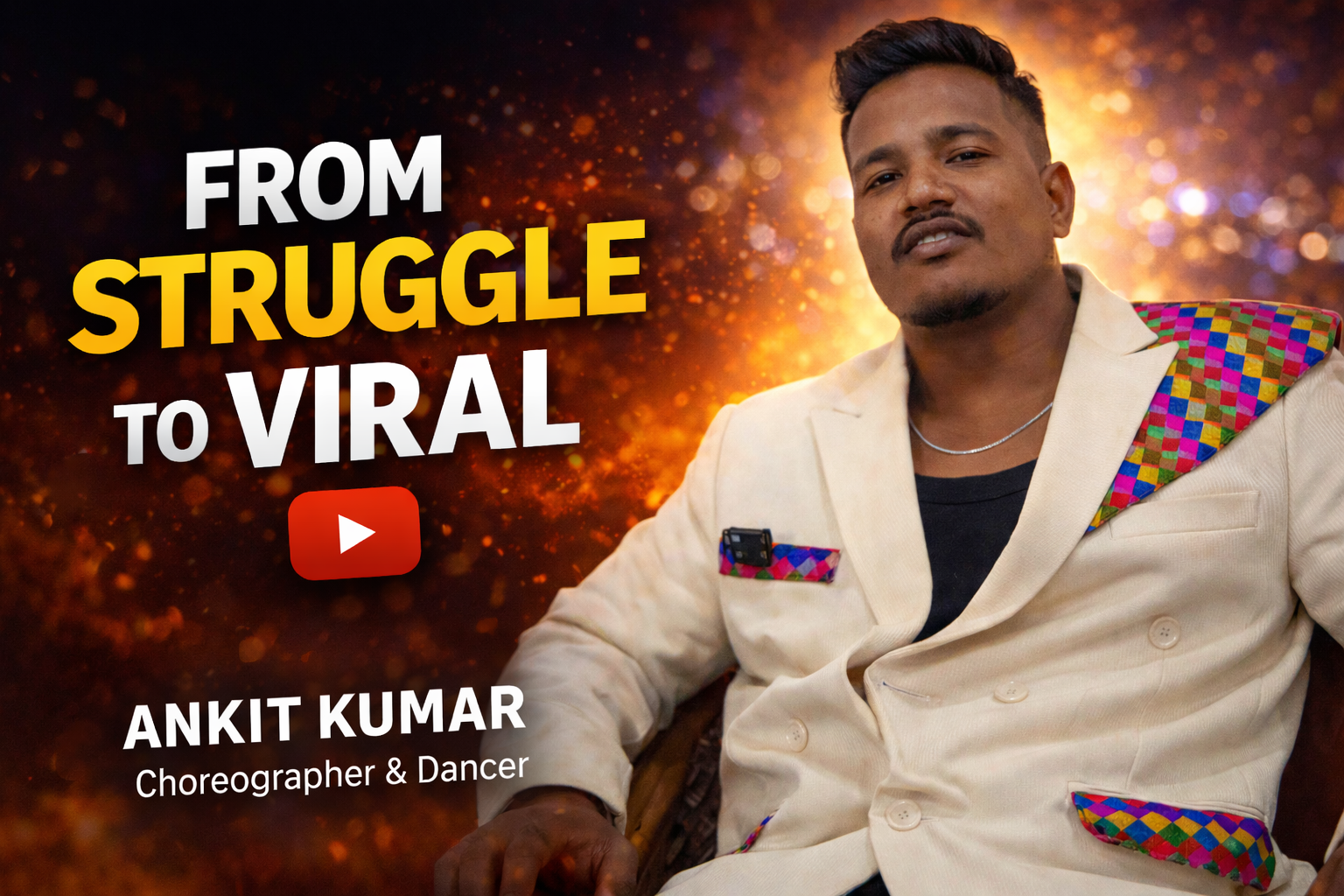
From a Student in Almora to a Choreographer Known Across Uttarakhand
Every successful creative journey has a phase that people rarely see.
Before the recognition, there is usually uncertainty.
Before the big song, there are smaller opportunities.
Before people know your name, there are years of learning, experimenting, struggling and trying to understand where you actually belong.
The conversation with Ankit Kumar on The Socialens Talks takes us through exactly that kind of journey.
Ankit Kumar is a choreographer and artist from Uttarakhand whose journey moved from dance and martial arts to professional choreography and large-scale music projects.
His story includes years spent in Almora, learning dance largely through whatever opportunities were available, dealing with questions about career and stability, and eventually finding his own creative identity.
What makes the conversation particularly interesting is that it is not simply about fame.
It is about finding an art form, developing a personal style and continuing to work even when the outcome is uncertain.
Almora Became an Important Part of His Journey
When Ankit came to Almora for his studies, the beginning was not easy.
He described his first year as a period when he hardly knew anyone and had to adjust to a completely new environment.
There were moments when he even felt like leaving.
But gradually, he became familiar with the place, connected with people and built friendships and memories that stayed with him.
He eventually spent around eight years connected with Almora.
The experience included college life, friendships, local places and the environment that became an important part of his personal and creative journey.
For Ankit, the mountains were not simply a location.
They became part of his identity and creative environment.
The Journey Behind Gulabi Sharara
One of the biggest milestones discussed in the conversation was Gulabi Sharara.
Ankit had already worked on many songs before that project.
He explained that when he worked on the song, there was no certainty that it would become such a massive success.
At one point, the song had remained around the tens of thousands of views for months, and people associated with the project even considered it unsuccessful.
Then everything changed.
The song suddenly started gaining attention.
Its dance steps became widely copied and the song moved beyond Uttarakhand, reaching audiences outside India as well.
Ankit described the experience as almost magical because the response came after a long period when nobody expected such a result.
The success eventually became an important turning point in his career.
For him, it was also evidence that years of work could eventually create an opportunity that nobody could predict in advance.
Building a Personal Dance Style Took Years
One of the most valuable parts of the conversation is Ankit’s explanation of how he developed his choreography style.
He did not simply copy one established dance form.
Instead, he experimented with a combination of influences.
He talked about bringing together Hindi/Bollywood patterns with elements of Pahadi dance, along with styles he had learned during his years of dancing.
The goal was to create something that had:
- a distinctly Pahadi character
- traditional movement
- folk influence
- Western energy
- and a contemporary visual feel
But creating that identity did not happen quickly.
Ankit said it took around two and a half years of experimentation and refinement.
He tried things that did not work, identified mistakes and continued improving the style.
Even today, he considers that process unfinished and continues thinking about how to improve it further.
That is an important insight into creative work:
A personal style is usually developed through experimentation, not discovered fully formed.
From Dance to Choreography
Ankit’s relationship with dance started before professional choreography.
He had been interested in dance while growing up and was influenced by watching shows such as Dance India Dance and Dance Plus.
At home, his family watched these programmes, and seeing other dancers appear on television gave him a picture of what might be possible.
At the same time, living in a village environment meant that opportunities and information were limited.
He did not initially know where auditions happened or how someone from the mountains could enter the larger dance industry.
Much of the early learning happened through practice at home.
Eventually, after completing college, the question of career became more serious.
People around him began asking what he was going to do professionally.
At that stage, surviving as a dancer was difficult.
There were moments when he seriously considered leaving dance.
When Giving Up Seemed Like an Option
After college, Ankit faced the practical reality of building a career.
He had responsibilities.
He also had experience as a Taekwondo coach and was running an academy, which gave him another possible direction.
There were periods when he thought about finding another source of income and moving away from dance.
But opportunities gradually started appearing.
One of the early opportunities came through a channel that gave him a chance to work as a choreographer.
A song he worked on around 2015–16 received around three lakh views, which, according to Ankit, was significant for that period.
That experience helped him believe that choreography could become a serious professional path for him.
His Family’s Expectations Changed With His Journey
Ankit also spoke openly about how his family’s attitude changed over time.
Earlier, family members did not necessarily understand the creative industry or know where his work might lead.
As his career developed, they became more involved.
They started watching his videos, following new releases and even keeping track of developments in the industry.
He also spoke about using his earnings to improve things at home and buying useful household items for his parents.
There were still future goals and dreams he wanted to fulfil for them.
His story therefore isn’t only about professional recognition.
It also includes the personal desire to make his family proud and improve their circumstances through his work.
Creativity Does Not Always Happen in Two Hours
Ankit gave an interesting insight into what actually happens behind choreography.
Sometimes a song connects with him immediately and choreography can develop within a couple of hours.
But other songs can take several days.
For him, the difference is between simply creating a sequence and creating something distinctive.
He explained that a choreographer can make something quickly as a formality.
But creating a movement that feels new or presenting an existing idea in a different way requires much more thought.
Sometimes he can spend an entire night trying to find the right movement.
If nothing works, he may stop and return to it the next day.
That distinction is important:
Speed and creativity are not always the same thing.
The Story Behind the Gulabi Sharara Choreography
Ankit also described how much time and energy went into creating choreography for his projects.
For one portion of Gulabi Sharara, he worked late at night, roughly from 1 AM to 3:30 AM.
Another project, Pingli Sadee, took several days, with individual steps developed gradually.
He recalled spending an entire night working on the choreography and then going directly to the set.
The reason was simple: the song had become so deeply connected to him that he kept working until the movement felt right.
This gives a different perspective on viral content.
What viewers may see as a short dance sequence can represent hours or even days of creative work behind the scenes.
Around 200 Songs and a Long Creative Career
During the conversation, Ankit discussed the scale of his work.
He estimated that he had worked on around 180–200 songs or more, including a large number associated with Uttarakhand.
He also mentioned that approximately 40–50 songs had become successful or received significant attention.
The numbers show that Gulabi Sharara was not the beginning or end of his career.
It was one major milestone within a much larger body of work.
Not Every Song Gets the Same Treatment
Ankit explained that he has become more selective about the projects he accepts.
If around ten songs come to him, he may choose only a few.
His decision depends on several factors:
- the quality of the music
- the feel of the song
- the team
- the available budget
- and whether he personally connects with the project
He believes the entire team contributes to a successful song.
The choreography is important, but it works alongside music, performance, direction and other creative elements.
The Difference Between a Dancer and an Artist
Perhaps one of the most personal parts of the conversation came when Ankit spoke about what it means to become an artist.
He explained that he originally danced partly for fun while his primary background was in Taekwondo.
But at some point, dance became emotionally meaningful.
He connected with it more deeply.
For him, an artist has to recognise the art within themselves and perform from a genuine emotional connection rather than simply executing movements.
That realisation became particularly strong during a difficult personal period.
How a Difficult Personal Phase Changed His Relationship With Dance
Ankit shared that a breakup around 2018–19 became an unexpected turning point in how he experienced dance.
During that emotional period, he would go to a place in the forests around Almora where he used to practise.
He would put on music and simply move.
There was no fixed choreography.
No audience.
No performance.
He described it as allowing his emotions to come out through movement.
For him, that experience demonstrated something important:
Dance was not only a profession or physical activity. It had become an emotional language.
That emotional connection eventually became an important part of how he viewed himself as an artist.
COVID, Financial Pressure and the Decision Not to Quit
The journey was not always moving upward.
During COVID, Ankit described a particularly difficult phase.
Classes stopped.
He became ill with COVID and spent a period in quarantine.
His roommates had also left, leaving him largely alone.
He continued practising in his room and on the terrace, trying to remain connected with dance.
Later, financial pressure became more serious.
College was complete, responsibilities were increasing and there were practical expenses to manage.
Family members and friends sometimes suggested that he should take a job rather than continue pursuing dance after so many years.
At that point, he had already spent around seven or eight years pursuing the field.
The question was obvious:
What had he achieved after all those years?
Yet he decided not to quit.
He gave himself more time and continued working.
Eventually, that persistence began producing results.
Social Media: Praise, Criticism and Learning Not to React
With visibility comes criticism.
Ankit spoke about receiving negative comments on social media and how he initially felt affected by them.
Over time, however, he learned that social media contains many different kinds of people.
Some people may focus on finding one negative point and repeatedly discuss it.
But he also pointed out that the number of people who appreciate talent can be much larger than the visible criticism.
His approach eventually became to keep moving forward rather than allowing every comment to influence his work.
Competition Can Also Push an Industry Forward
When asked about competition in the Uttarakhand creative industry, Ankit did not describe competition simply as something negative.
He said that some level of competition is necessary because it pushes people to work harder.
He also noted that more dancers and choreographers entering the field can benefit the industry if they bring something new.
In his view, when more creative people experiment, the overall industry can develop.
Fame Is Easier to Get Than to Maintain
One of Ankit’s clearest observations was about fame.
According to his perspective, becoming famous can be relatively easy today.
Staying relevant and retaining people’s respect is much harder.
He connected long-term recognition with authenticity.
A person can become visible through many different methods, but if they want to remain in people’s hearts, they have to remain genuine and continue developing as an artist.
He also made an important distinction between “real” and “reel” content.
He does not consider reels inherently wrong.
They can provide entertainment and allow creators to showcase their talent.
But he believes creators should remain genuine even within that format.
His Career Could Have Taken Several Different Directions
Ankit’s journey could easily have gone somewhere else.
If choreography had not worked out, he said he could have continued as a martial-arts coach or artist.
He had also considered teaching drawing.
He had an interest in sports and played cricket extensively while growing up.
He even cleared a trial for the armed forces but was eventually unable to continue because of documentation/federation-related issues.
Looking back, dance was not necessarily a predetermined destination.
It became his path through a combination of interest, opportunity, persistence and circumstances.
The Importance of Creating Your Own Identity
Another interesting aspect of Ankit’s work is his attention to visual identity.
He discussed experimenting with clothing and adding his own design elements rather than simply wearing standard outfits.
The same philosophy appears in his choreography.
He wants his work to have something identifiable and different.
That search for individuality is visible in his attempt to combine Pahadi movement with contemporary and Western influences.
His creative journey therefore isn’t only about doing more work.
It is also about finding a recognisable artistic language.
What Comes Next for Ankit Kumar?
Ankit made it clear that he does not consider his journey finished.
He wants to continue working on bigger projects and hopes to take Uttarakhand’s music and creative work to audiences beyond India.
He also expressed interest in working in Bollywood and said there are future projects he hopes to explore.
For him, the goal is not simply to repeat the success of one song.
He wants to create another project capable of taking Uttarakhand’s creative identity to a much larger audience.
Ankit Kumar’s Message to Young People
The closing message of the conversation was especially relevant for young viewers.
Ankit’s advice was to have a dream that demands genuine effort.
Not just a dream that sounds attractive.
A goal that keeps you occupied, focused and committed.
He suggested continuously setting new goals rather than believing that one achievement means the journey is finished.
His broader message was that staying focused on meaningful goals can help young people avoid getting pulled into harmful distractions and unhealthy habits.
He also encouraged people to support Uttarakhand’s artists, culture and creative ecosystem.
What We Can Learn From Ankit Kumar’s Journey
Ankit’s conversation offers several practical lessons:
1. Your first phase may not look successful
His journey included years when opportunities were limited and even quitting seemed possible.
2. A personal style takes time
His choreography style developed through years of learning, experimenting and correcting mistakes.
3. Success can arrive unexpectedly
Gulabi Sharara initially did not look like an obvious blockbuster. Its major growth came later.
4. Creative work requires patience
Some choreography may take hours, while other projects can require several days of experimentation.
5. Difficult experiences can influence creativity
For Ankit, an emotionally difficult period helped him connect with dance at a deeper level.
6. Fame and longevity are different things
Getting attention is one thing; maintaining authenticity and continuing to create is another.
7. Keep setting new goals
For Ankit, achieving one goal should not mean losing the hunger to improve.
Why This Conversation Matters
Ankit Kumar’s story is particularly relevant for young people interested in dance, choreography, music, content creation and creative careers.
It shows a side of the creative industry that is often missing from social media.
People see the final performance.
They may see millions of views.
They may see recognition.
But behind those visible results are years of practice, uncertainty, financial pressure, criticism, personal setbacks and countless decisions about whether to continue.
Ankit’s journey provides a more complete picture of that process.
It also shows how a regional creative identity can become part of a larger contemporary artistic language.
Who Should Watch This Conversation?
This episode may be particularly useful for:
- Aspiring dancers
- Choreographers
- Young artists
- Content creators
- Music and entertainment enthusiasts
- Students considering creative careers
- People interested in Uttarakhand’s music and culture
- Anyone trying to build a career around a creative skill
Watch the Full Ankit Kumar Conversation
🎥 Watch Ankit Kumar on The Socialens Talks:
https://www.youtube.com/watch?v=mBnTuqs3fcE
The full conversation goes beyond the highlights above and includes Ankit’s experiences with dance, choreography, career decisions, social media, creativity, personal struggles and his message for young people. The episode is listed as EP13 on the current Episodes directory.
Related Conversations on The Socialens Talks
Sahil Diwan — Childhood, Parenting & Screen Time
A very different perspective on childhood, toys, parenting and the changing relationship between children and technology.
Read: https://thesocialenstalks.com/sahil-podcast/
Watch: https://www.youtube.com/watch?v=3RWsGEHCi2g
Arjun Thapa & Anamika Raj — Acting, Career & Life Behind the Camera
A conversation about acting, opportunities, career decisions and the realities behind the entertainment industry.
Read: https://thesocialenstalks.com/arjun-thapa-anamika-raj-podcast/
Watch: https://www.youtube.com/watch?v=vY2M6o87n8o
Amit Nautiyal — Music, Dance & Creative Growth
Another creative journey exploring music, performance, discipline and the challenges of building a career through art.
Read: https://thesocialenstalks.com/amit-nautiyal-podcast/
Watch: https://www.youtube.com/watch?v=LFpC0wn_4nk
Frequently Asked Questions
Who is Ankit Kumar?
Ankit Kumar is a choreographer and artist from Uttarakhand whose work includes choreography for numerous regional music projects. His conversation on The Socialens Talks explores his journey from dance and martial arts to professional choreography.
What is Ankit Kumar known for?
The conversation prominently discusses his choreography work, including Gulabi Sharara, along with his broader work in Uttarakhand’s music and creative industry.
How did Ankit Kumar get into choreography?
He initially practised dance while also being involved in Taekwondo. After college and several uncertain phases, opportunities gradually led him from being a dancer toward professional choreography.
How long did it take Ankit to develop his dance style?
He described spending around two and a half years experimenting with and refining a style combining Pahadi, folk and contemporary influences.
What did Ankit say about social media criticism?
He explained that negative comments initially affected him, but over time he learned to focus on continuing his work rather than reacting to every comment.
What is Ankit Kumar’s message for young people?
His message is to set meaningful goals that require genuine effort, stay focused on those goals, keep creating new targets after achieving one, and support the creative and cultural work happening in Uttarakhand.