
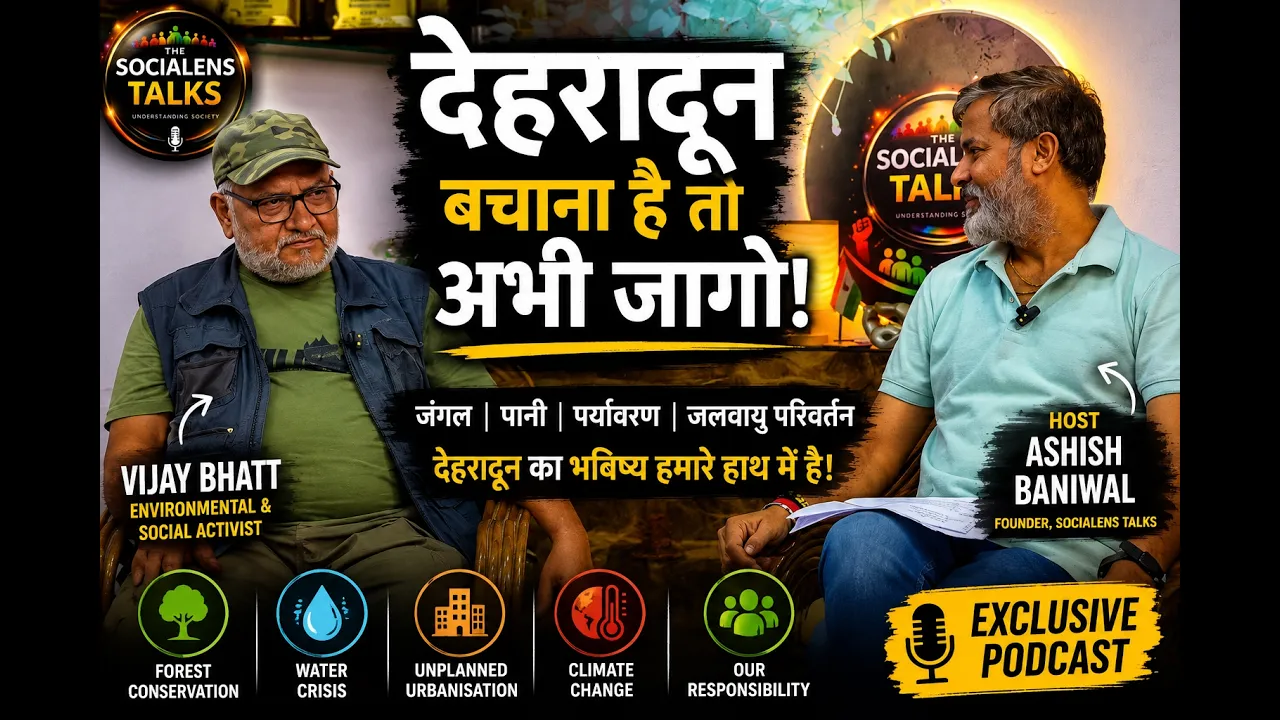
Introduction
What happens when the environment is not just a subject, but a part of your own life?
For Vijay Bhatt, the answer comes from lived experience.
He was born, raised and educated in the same place where he has spent much of his life. His memories are connected with the local air, water, landscape, rivers, canals and forests. Over time, he has also watched many of those surroundings change.
In this conversation on The Socialens Talks, Vijay Bhatt discusses his relationship with nature and the environmental changes he has witnessed around Dehradun and Uttarakhand.
The discussion moves from forests and water to groundwater, rivers, urbanisation, concretisation, waste management, local geography and the importance of understanding the natural systems around us.
It is a conversation about nature, but it is equally a conversation about how we live, how we build and how we plan for the future.
A Personal Connection with Nature
Environmental awareness can begin in many ways.
For Vijay Bhatt, it began with his surroundings.
He describes himself as someone who has had a strong connection with nature from an early stage of life. His childhood relationship with rivers, canals and forests was not theoretical. These natural resources were part of everyday life.
Forests provided resources.
Water was needed for agriculture.
Water was also needed for everyday household use.
The relationship between people and nature was therefore much more direct than it often is today.
This personal connection is one of the most interesting parts of the conversation because it shows how environmental awareness can emerge from simply observing the place where we live.
Watching Dehradun Change
One of the strongest parts of Vijay Bhatt’s conversation is his recollection of how the landscape around Dehradun has changed.
He talks about seeing rivers and natural channels change over time, traditional orchards disappear and open spaces increasingly replaced by large constructions.
He recalls ber bushes, semal and malta trees, as well as basmati cultivation, litchi orchards and tea gardens, becoming less visible in the landscape he remembers.
These observations make the environmental discussion much more tangible.
Environmental change is not always visible through statistics alone.
Sometimes it is visible when a tree that was once common becomes difficult to find.
Or when an orchard disappears.
Or when a natural water channel is no longer recognisable.
For someone who has spent decades observing the same landscape, these changes become part of personal memory.
Why Forests and Water Are Connected
A major theme of the episode is the relationship between forests and water.
When asked about the scientific connection between forests and water, Vijay Bhatt explains the relationship through the natural movement of water and the role forests play in that system.
His explanation connects forests with the movement and retention of water in the environment.
This is important because water does not exist in isolation.
Rainfall, soil, vegetation, groundwater, rivers and local ecosystems are connected.
When natural systems are disturbed, the effects can appear elsewhere.
The conversation therefore encourages listeners to think about forests not merely as groups of trees, but as part of a much larger environmental system.
From Canals to Changing Local Ecology
Vijay Bhatt also talks about the role that canals once played in the local environment.
According to his recollection, canals contributed not only to agriculture but also to the moisture and local environmental conditions around them.
He connects the decline of such systems with changes in agriculture, local moisture and the disappearance of some species.
This is an important reminder that environmental systems are often interconnected in ways that may not be immediately obvious.
A canal may appear to be only a water channel.
But its presence can influence agriculture, soil moisture, vegetation and the surrounding ecosystem.
When such systems disappear, the impact can extend beyond the water itself.
Urbanisation and the Decline of Groundwater
The conversation then moves toward one of the major environmental concerns associated with growing cities: groundwater.
Vijay Bhatt discusses how increasing urbanisation is associated with declining groundwater levels and changes in rivers.
He also raises concerns about polluted water entering natural systems and the damage this can cause to river ecosystems.
This brings the discussion back to a basic question:
Where does the water go when the natural ground surface is increasingly replaced by concrete?
Urban development changes the way rainwater interacts with the ground.
That makes planning and local geography particularly important.
Concretisation and the Natural Water Cycle
One of the more detailed sections of the conversation deals with concretisation.
Vijay Bhatt explains how increasing concrete surfaces can influence heat and the movement of water.
He discusses how natural surfaces such as fields and forests interact with water differently from heavily concretised areas, and connects these changes with local rainfall and environmental patterns.
This leads to a broader issue:
When cities are built, are we considering the natural systems that existed before the construction?
Roads, buildings and paved surfaces are necessary parts of modern cities.
But the way they are planned can influence drainage, groundwater recharge, heat and the movement of rainwater.
That is why urban development cannot be considered separately from local geography.
Development and Environment: Are They Really Opposites?
The episode directly raises an important question:
Are development and environmental protection necessarily opposite to each other?
The discussion does not reduce the issue to a simple choice between development and nature.
Instead, it brings attention to planning.
Development can change landscapes.
Urbanisation can increase pressure on water systems.
Tourism can increase waste.
Construction can alter natural drainage.
The real challenge is therefore understanding the environmental conditions of a place before planning how that place should grow.
This is particularly relevant to regions where geography, water systems, forests and settlements are closely connected.
Waste Management and the Reality on the Ground
Another practical part of the conversation focuses on waste and everyday cleanliness.
Vijay Bhatt recalls an older system in which water was sprinkled while sweeping roads to prevent dust from rising.
He contrasts that with present-day practices where sweeping can simply push dust into the air and garbage vehicles may also spread dust and waste along the route.
He also discusses plastic waste and the visible impact of poor waste management.
This part of the conversation is useful because it moves the environmental discussion away from abstract ideas and into ordinary daily life.
Environmental responsibility is not only about forests and rivers.
It is also about:
- how waste is collected,
- how it is transported,
- where it is treated,
- and what eventually happens to it.
Waste Management Needs Planning
The conversation also raises a broader issue around increasing tourism and pilgrimage activity.
Vijay Bhatt questions whether planning focuses only on how many visitors can arrive, without adequately planning how they will be accommodated and how their waste will be managed.
He specifically points to the need for proper planning around waste treatment and infrastructure.
This creates an important distinction:
Having the capacity to receive visitors is not the same as having the capacity to manage their environmental impact.
For environmentally sensitive areas, both need to be considered together.
The Loss of Local Biodiversity
Another valuable part of the conversation is Vijay Bhatt’s discussion of changes in local plant life and species.
He remembers trees and plants that were once more common and describes how changes in canals, agriculture and the wider landscape have affected local ecological conditions.
This shows why environmental conservation is not only about protecting large forests.
It can also mean protecting:
- local plants,
- traditional agricultural systems,
- water channels,
- natural habitats,
- and the ecological relationships that develop around them.
When these disappear, part of the local identity can disappear with them.
Why Local Geography Matters
One of the most practical suggestions from the conversation is the importance of understanding local geography.
Vijay Bhatt argues that students should first understand the geography around their own homes and communities before moving toward broader geographical concepts.
He explains that local geography should not simply be studied from books; it should also be understood by observing and experiencing the surroundings—such as ridges, water distribution and the way the landscape functions.
This idea is particularly relevant in Uttarakhand.
Understanding where water comes from, how it moves, where natural drainage exists and how settlements interact with hills and forests can help people understand why certain environmental problems occur.
Environmental Protection Begins With Awareness
Vijay Bhatt’s approach to environmental work is also grounded in persistence.
He compares environmental efforts with the familiar image of a bird trying to put out a fire by carrying one drop of water at a time.
The comparison reflects a simple idea:
Even when the problem is much larger than an individual, making an effort still matters.
Environmental problems can feel overwhelming.
Deforestation, water shortages, pollution and urbanisation cannot be solved by one person.
But awareness, community action, responsible planning and consistent effort can all contribute to change.
What Can We Learn From Vijay Bhatt’s Conversation?
The conversation offers several practical ideas:
- Nature is connected to everyday life, not separate from it.
- Forests and water systems need to be understood together.
- Local rivers, canals and natural drainage systems are important parts of the environment.
- Urbanisation changes how water moves through a landscape.
- Excessive concretisation can affect natural water processes.
- Waste management needs proper planning and infrastructure.
- Local biodiversity and traditional ecological systems deserve attention.
- Development needs to consider the geography and environmental conditions of the area.
- Local geography can be understood through observation as well as education.
- Environmental work requires continuous effort, even when results are gradual.
Why This Conversation Matters for Uttarakhand
For Uttarakhand, environmental questions are closely connected with everyday life.
Forests.
Water.
Rivers.
Hills.
Tourism.
Agriculture.
Urban growth.
Waste.
These are not isolated subjects.
They interact with one another.
Vijay Bhatt’s conversation is valuable because it brings these issues down to the local level. Instead of discussing the environment only as a global concept, the conversation asks us to look at the places we actually live in.
The changing landscape of Dehradun becomes a starting point for thinking about much larger questions of development, water and environmental responsibility.
Who Should Watch This Conversation?
This episode may be particularly relevant for:
- Students interested in environment and geography
- Residents of Uttarakhand
- Environmental volunteers
- Nature and sustainability enthusiasts
- Teachers and educators
- Community organisations
- People interested in Dehradun’s changing landscape
- Anyone interested in the relationship between development and nature
Watch the Full Vijay Bhatt Conversation
🎥 Vijay Bhatt | जंगल खत्म हुए तो पानी भी खत्म होगा? Uttarakhand की बड़ी चिंता | EP 19
Watch on YouTube:
https://www.youtube.com/watch?v=FpxSarf0VlY
The conversation covers Vijay Bhatt’s experiences with nature, forests, rivers, water, urbanisation, environmental change and the changing landscape of Dehradun.
Related Conversations on The Socialens Talks
If you found Vijay Bhatt’s conversation interesting, you can also explore other conversations on The Socialens Talks that discuss education, social awareness, values and life experiences.
Prof. H. C. Purohit — Education, Youth & Future
Prof. H. C. Purohit discusses education, students, career challenges, emotional support and the changing mindset of young people.
Read:
https://thesocialenstalks.com/prof-hc-purohit-podcast/
Watch:
https://www.youtube.com/watch?v=ba18t75T5lE
Kuldeep Singh Dharwal — Poetry, Emotions & Society
Kuldeep Singh Dharwal’s conversation explores poetry, writing, emotions, social messages and the changing culture of digital content.
Read:
https://thesocialenstalks.com/kuldeep-singh-dharwal-podcast/
Watch:
https://www.youtube.com/watch?v=x0rNdZuDbvI
Priya Gulati — Journalism, Social Awareness & Human Values
Priya Gulati’s conversation explores journalism, social awareness, women empowerment, leadership and community impact.
Read:
https://thesocialenstalks.com/priya-gulati-podcast/
Watch:
https://www.youtube.com/watch?v=yqb-NOmPGnc
Frequently Asked Questions
Who is Vijay Bhatt?
Vijay Bhatt is a guest featured on The Socialens Talks whose conversation focuses on environment, forests, water, local geography, urbanisation and the changing landscape of Dehradun and Uttarakhand.
What is Vijay Bhatt’s podcast about?
The episode discusses his personal connection with nature and his observations about forests, rivers, canals, groundwater, urbanisation, concretisation, waste management and environmental change.
Why are forests and water connected?
The conversation explains the relationship between forests and the movement and availability of water within natural systems. Forests are discussed as an important part of the broader water cycle.
What environmental changes does Vijay Bhatt discuss?
He discusses changes in forests, rivers, canals, groundwater, agricultural landscapes, orchards, natural vegetation, urbanisation and waste management.
What does Vijay Bhatt say about Dehradun’s changing landscape?
He recalls changes in natural areas, orchards, agricultural landscapes and water systems, along with the growth of large constructions and urbanisation.
Why is local geography important?
The conversation highlights the value of understanding the geography around us—including water distribution, ridges and local natural systems—rather than treating geography only as a textbook subject.
What does the episode discuss about waste management?
The conversation discusses everyday waste collection, dust, plastic waste, treatment systems and the need to plan waste management alongside tourism and urban development.
Final Thoughts
Vijay Bhatt’s conversation is ultimately about something very simple:
The environment is not somewhere far away.
It is around us.
It is the water we use.
The forests we see.
The rivers we depend on.
The land we build upon.
The air we breathe.
And the landscape we leave behind.
His memories of Dehradun and his observations of environmental change provide a personal perspective on issues that are often discussed only in technical terms.
The conversation encourages us to look more carefully at our surroundings and ask a basic question:
Before changing a place, do we understand how that place naturally works?
Because protecting nature is not only about preserving the past.
It is also about understanding the present—and making thoughtful choices about the future.