
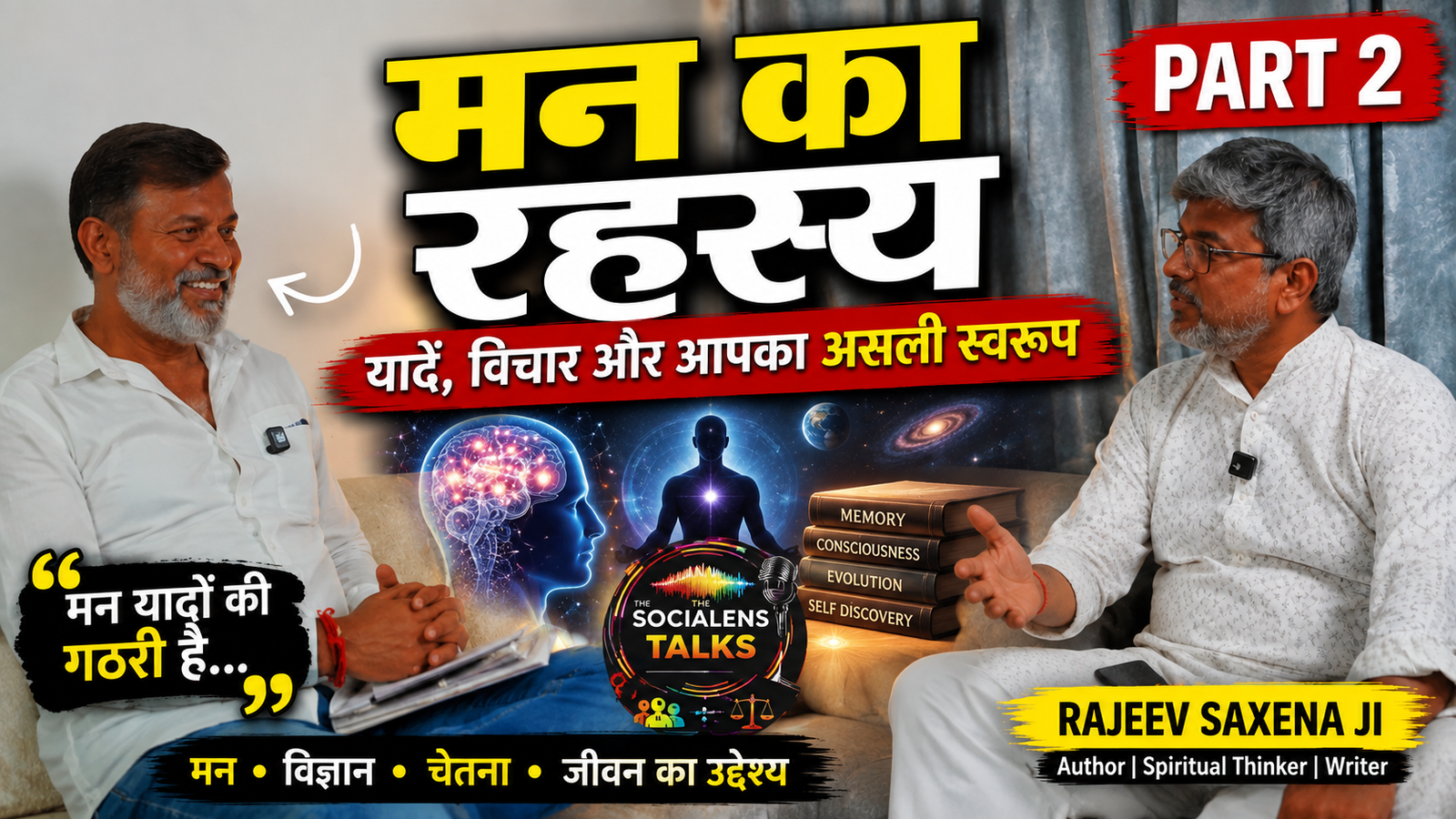
Rajiv Saxena Part 2: Mind, Memory, Inner Peace & the Journey Within
What exactly is the mind?
Is the mind simply a collection of memories, or is there something deeper behind the way we think, feel and act?
In the second part of our conversation with Rajiv Saxena, we continue our exploration of the mind, consciousness, memory, spirituality and inner peace. The discussion moves from the evolution of human thought to the relationship between mind and memory, from the idea of chitta to the role of breath, and from the search for success to the deeper question of knowing oneself.
Rather than presenting spirituality as something separate from everyday life, this conversation examines how our thoughts, emotions, actions and experiences are connected to the way we understand ourselves.
Note: This article is based on the conversation featured in The Socialens Talks episode with Rajiv Saxena. The spiritual and philosophical explanations discussed below represent the perspectives expressed during the conversation.
Understanding the Mind as a Bundle of Memories
One of the starting points of the conversation is a simple but important question:
What is the mind?
Rajiv Saxena explains the mind in terms of memories—a “bundle of memories.” The conversation then goes deeper by asking how this collection of experiences developed in the first place.
This takes the discussion beyond the usual idea that the mind is simply where we think.
According to the perspective discussed in the episode, human experience accumulated gradually. As human beings experienced different situations, they began observing, remembering, comparing and imagining.
The result was an increasingly complex mental world.
From the Origin of the Universe to the Evolution of the Human Mind
Rajiv Saxena connects the discussion about the mind with two different ways of looking at the origin of existence.
One is the spiritual perspective, as understood through scriptures.
The other is the scientific perspective, including the Big Bang theory.
During the conversation, he explains that the spiritual description of creation and the scientific discussion of cosmic origins are being approached as two different frameworks for understanding the same broad question of existence.
The conversation then moves from the universe to Earth, from Earth to life, and eventually to human beings.
This long journey provides the background for a much more specific question:
How did the human mind become what it is today?
The Cognitive Revolution and the Rise of Human Thought
One of the most interesting parts of the conversation is the discussion of the Cognitive Revolution.
Rajiv Saxena describes a major development in human evolution in which humans began developing the ability to imagine, generate ideas, collect experiences and analyse them.
A simple example discussed in the conversation is the experience of heat and shade.
A person experiences heat.
Then they experience shade.
The mind begins to recognise that if one thing exists, perhaps another possibility also exists.
That ability to imagine something beyond the immediate experience becomes an important part of human thinking.
Rajiv Saxena explains that the development of imagination, thought and memory happened gradually over thousands and millions of years rather than appearing suddenly.
Why Memory Became So Important
As human beings accumulated experiences, the ability to remember those experiences became increasingly important.
The conversation uses the experience of death as an example.
Early humans had no formal education, language or established knowledge systems. They had to understand their surroundings through direct experience.
The recognition that a person who had been alive was no longer responding would itself have been an important learning experience for early human beings.
Over time, experiences accumulated.
Thought developed.
Imagination developed.
And memory became an increasingly important part of human mental life.
This leads naturally to the distinction Rajiv Saxena makes between mind and chitta.
Mind and Chitta: The Difference Discussed in the Conversation
One of the distinctive concepts discussed in this episode is the difference between मन (mind) and चित्त (chitta).
Rajiv Saxena explains the mind as being connected with the experiences of the present life, while he describes chitta in relation to accumulated experiences beyond the immediate memories of the current life.
To make the idea easier to understand, he gives a modern analogy:
The Mobile Phone and Cloud Storage
Imagine your phone.
Some information is stored directly on the phone.
Other information is stored in the cloud.
According to the analogy used in the conversation:
- Phone memory → Mind
- Cloud memory → Chitta
The two are described as connected and available through the same overall system of experience.
This analogy makes an otherwise abstract philosophical idea easier to visualise.
How Language Changed Human Thought
The conversation then moves to another major development: language.
Once human beings developed the ability to communicate ideas with one another, experiences no longer remained limited to one individual.
Knowledge could be shared.
One person could tell another person what they had seen or experienced.
Rajiv Saxena explains that the exchange of ideas accelerated the development of knowledge and human thought.
The conversation gives a simple example involving Dehradun and the mountains.
If one person lives in Dehradun and another person has never seen mountains, the first person can describe mountains to them.
That exchange creates knowledge in another person’s mind.
This is one of the ways conversation itself becomes part of human learning.
When the Mind Becomes Difficult to Control
As human experience, knowledge and thought became more complex, Rajiv Saxena argues that the modern mind also became increasingly complicated.
The result is an interesting contradiction:
The mind belongs to us, but we often feel that we do not control it.
He explains that spirituality, in the framework discussed during the episode, is concerned with going beyond the limitations created by the mind.
The discussion then introduces the concept of different layers through which the deeper self is understood.
The idea is that discovering one’s real nature is difficult because it appears to be covered by multiple layers of experience and identity.
What Is Inner Peace?
The conversation then arrives at one of its central questions:
What exactly is inner peace?
Instead of immediately discussing techniques for achieving it, Rajiv Saxena first asks us to understand what we actually mean by inner peace.
He explains that physical discomfort, financial difficulties and other forms of suffering can exist in different ways. But when we talk about peace, the discussion moves towards mental calmness.
A person may have material comforts, facilities and possessions.
But if the mind remains disturbed, those external comforts may not create a feeling of peace.
This becomes an important distinction in the episode:
Outer comfort and inner peace are not necessarily the same thing.
Why Do We Keep Searching for Happiness?
Another interesting part of the conversation is the relationship between the mind and our constant search for happiness.
Rajiv Saxena explains that human beings naturally seek सुख—comfort, happiness and satisfaction.
We look for it in food, sleep, surroundings, experiences and many other things.
But when what the mind wants does not happen, dissatisfaction can follow.
This creates a cycle:
Desire → Thought → Action → Result → Happiness or Disappointment
And the cycle continues.
How Thoughts Become Actions
One of the most detailed explanations in the episode concerns the sequence between emotion, thought, intellect and action.
Rajiv Saxena describes it broadly as:
भाव → विचार → बुद्धि → कर्म
In the conversation, he explains that an emotional state can give rise to related thoughts. Among the many thoughts occurring in the mind, the intellect selects one, and that selected thought can then become an action.
This provides an interesting way of looking at everyday behaviour.
Before asking:
“Why did I do this?”
we can also ask:
“What was happening inside me before I acted?”
That question shifts attention from the visible action to the internal process behind it.
The Mind and Inner Peace
Rajiv Saxena describes the mind as a major controlling force in human experience.
According to the perspective expressed in the conversation, inner peace becomes difficult when the mind remains disturbed or constantly active.
The discussion therefore returns repeatedly to the same central idea:
To understand inner peace, we first need to understand the mind.
Can a Person Change?
The conversation also explores why people can change dramatically.
A person may behave one way at one point in life and very differently later.
Rajiv Saxena uses the example of Valmiki to illustrate the idea that transformation can be understood as a transformation of the mind rather than merely a physical change.
The larger point of the discussion is that when the underlying thought process changes, behaviour can also change.
This makes self-understanding relevant not only to spirituality but also to personal development.
The Connection Between Breath and the Mind
One of the strongest links between Part 1 and Part 2 of the conversation is breath.
Rajiv Saxena explains that although the mind itself cannot be directly seen, breathing can be experienced.
He describes breath as the physical or observable expression associated with the state of the mind and argues that changes in breathing are connected with changes in mental state.
The conversation gives anger as an example.
When a person is angry, breathing may become faster.
The discussion then connects practices such as pranayama and meditation with regulating the pace of breathing.
Rajiv Saxena emphasises that slowing the breath should not be confused with simply holding the breath.
Experiencing the Transition Between Inhale and Exhale
A particularly interesting practical idea discussed in the episode is observing the transition between an incoming breath and an outgoing breath.
The conversation asks:
At exactly what point does the incoming breath become the outgoing breath?
Rajiv Saxena suggests observing that transition directly.
He relates this to a meditation practice discussed in the Vigyan Bhairav Tantra, where attention is placed on the breathing process.
The important aspect here is observation.
Instead of trying to force an experience, the conversation encourages paying attention to something that is already happening naturally.
Why Rajiv Saxena Wrote Saas Ke Rahasya
The episode also explores the story behind Rajiv Saxena’s book Saas Ke Rahasya Jo Chahe So Paaye.
Interestingly, he explains that he did not originally set out to write the book.
He had been discussing his experiences and ideas with someone who would spend several hours listening to him. At one point, Rajiv Saxena wrote approximately 6,000–7,000 words to explain the subject.
That material was then suggested as something that should be developed into a book.
According to the conversation, the material eventually expanded considerably, becoming a much larger manuscript.
This gives the book a different origin story from a conventional writing project.
Where Should Someone Start With Spirituality?
The host asks an important practical question:
If someone wants to start their spiritual journey, where should they begin?
Rajiv Saxena challenges the idea of treating spirituality simply as something one “starts.”
His explanation is that spirituality is essentially a form of self-study.
The question therefore becomes:
Who am I?
Rather than looking only outside for answers, the conversation turns attention inward.
The “Neti Neti” Approach to Self-Understanding
Rajiv Saxena discusses the idea of identifying what we are not as part of the process of understanding who we are.
This is connected in the conversation with the Vedantic idea of “Neti Neti” — not this, not this.
The approach discussed is to examine different aspects of our experience and ask whether each one represents our deepest identity.
The conversation connects this search for the self with the search for the divine.
In Rajiv Saxena’s explanation, these are not necessarily two completely separate searches.
“Brahma Satyam, Jagat Mithya” — What Does It Mean?
One of the philosophical statements discussed in the episode is:
“Brahma Satyam, Jagat Mithya.”
Rajiv Saxena points out that mithya should not simply be interpreted as “false” or “a lie.”
He explains the idea through everyday objects around us.
A table, sofa, wall, car or mobile phone may appear to be separate objects, but their material origins can be traced back to natural elements and resources.
The discussion then focuses on change.
Objects change gradually.
Buildings deteriorate.
Our bodies change.
Hair becomes grey.
Yet because these changes happen continuously and slowly, we often fail to notice the exact moment when the change occurs.
Within the philosophical framework discussed in the episode, this continuous change is part of understanding mithya.
What Is Spirituality?
When asked to define spirituality in a simple way, Rajiv Saxena brings the discussion back to the search for the real self.
The question is not merely:
“What do I believe?”
It becomes:
“Who am I?”
And if someone wants to understand God, the conversation suggests that understanding the self becomes part of that search as well.
Can Emotions Be Transformed?
The conversation also examines human emotions such as:
- Desire
- Anger
- Greed
- Attachment
- Fear
Rajiv Saxena explains that, in the perspective discussed, human beings have the ability to transform emotional states.
For example, he discusses the possibility of transforming anger into forgiveness or compassion and fear into fearlessness.
The emphasis is not on pretending that difficult emotions do not exist.
It is on understanding whether the emotional response can be transformed.
Bhagavad Gita and the Study of Spirituality
When asked about spiritual books, Rajiv Saxena refers to the Bhagavad Gita as a concise expression of ideas found across the Vedas and Upanishads.
He uses an analogy in which the Upanishads are compared with a cow and the Bhagavad Gita with the milk drawn from it—the idea being that the Gita represents a concentrated expression of broader spiritual teachings.
Silence Is More Than Not Speaking
Another memorable discussion concerns silence.
The host asks whether music or silence is more healing.
Rajiv Saxena distinguishes between external silence and inner silence.
Simply not speaking does not necessarily mean that the mind is silent.
A person can remain quiet externally while continuing a constant conversation internally.
According to the explanation in the episode, inner silence means reducing that internal mental noise.
The Everyday Example of Mental Noise
The episode gives a relatable example.
Imagine driving to the office.
Your body is travelling on the road, but your mind may already be at the office.
You may be thinking about:
- What you will do today
- What you will say to someone
- What work needs to be completed
Then something suddenly happens on the road and you have to brake.
For that moment, your attention returns completely to where your body actually is.
This example makes the idea of mental distraction easy to recognise in everyday life.
What Is Success?
The conversation takes an interesting turn when the host asks Rajiv Saxena about his definition of success.
His answer brings the discussion back to the mind.
If the mind sets a target and that target is achieved, the mind may call it success.
But once one target is achieved, another target can appear.
The cycle can therefore continue indefinitely.
This raises a useful question:
Are we pursuing success, or are we continuously pursuing the next demand created by our mind?
Are We the Master of Our Mind?
Rajiv Saxena uses a striking master-and-servant analogy to describe the relationship between a person and the mind.
The idea presented in the conversation is that we are supposed to be the master of our mind, but we can end up allowing the mind to become the master.
He describes the process of becoming free from this pattern as part of spiritual practice.
One practical suggestion emerges from this discussion:
Pause before acting.
Instead of immediately following every thought, take a moment and ask:
“Will doing this actually lead to something useful?”
That small pause can create space between thought and action.
Is Manifestation Real?
The rapid-fire section of the episode explores several contemporary questions.
One is manifestation.
Rajiv Saxena connects the question with the idea of the Law of Attraction, while also making an important distinction.
He does not suggest that every random thought automatically becomes reality.
Instead, he discusses the role of a strong or powerful intention and says that what we strongly think about can influence what happens around us.
This is presented as his perspective in the conversation rather than as a scientific conclusion established by the podcast.
Does Social Media Affect Spirituality?
Another rapid-fire question asks whether social media affects spirituality.
Rajiv Saxena separates the outer physical world from the inner spiritual journey.
His argument in the conversation is that spirituality concerns an internal journey and therefore should not be understood simply as something controlled by an external platform or object.
This leads to a broader question:
How much control do external circumstances actually have over our inner world?
Is Pain Necessary for Growth?
The discussion also touches upon pain and growth.
Rajiv Saxena explains that if pain is understood in the sense of a setback or a lesson, it can sometimes become part of learning and improvement.
The important factor is how the experience is understood.
A difficult experience does not automatically produce growth.
Reflection on that experience can become an important part of what comes next.
Forgiveness, Closure and the Mind
The final part of the conversation explores forgiveness and closure.
Rather than giving a simple yes-or-no answer, Rajiv Saxena questions the meaning of the word closure itself.
He explains closure as a mental process in which a person prepares themselves internally to live with what has happened.
Again, the discussion comes back to the same central theme:
The mind is involved in how we experience, interpret and respond to life.
Key Ideas From Rajiv Saxena’s Conversation
This episode covers several interconnected ideas:
1. The mind is closely connected with memory
The conversation describes the mind through the idea of accumulated experiences and memories.
2. Human thought evolved gradually
The discussion connects imagination, experience, analysis and memory with the development of human cognition.
3. Mind and chitta are discussed as different layers of memory
Rajiv Saxena uses the mobile-and-cloud analogy to explain this distinction.
4. Inner peace begins with understanding the mind
The conversation repeatedly returns to the relationship between mental disturbance and the experience of peace.
5. Breath is connected with mental state
The episode discusses breathing as an observable aspect connected with the state of the mind.
6. Spirituality is presented as self-study
The conversation frames spirituality around understanding oneself.
7. Inner silence is different from simply remaining quiet
The episode distinguishes external silence from reducing internal mental noise.
8. Success can keep moving because the mind keeps creating new targets
The discussion questions whether achieving one goal actually ends the search for success.
Why This Conversation Matters
The conversation with Rajiv Saxena moves between science, evolution, philosophy, spirituality and everyday human behaviour.
What makes the discussion particularly relevant is that many of its questions are not limited to spiritual practice.
They are questions people encounter in ordinary life:
- Why does the mind keep running?
- Why is it difficult to remain present?
- Why do we keep wanting more after achieving something?
- How do emotions influence our actions?
- What does inner peace actually mean?
- Can we understand ourselves better?
- What is the difference between external silence and inner silence?
- How much control do we really have over our thoughts?
The episode does not present these questions as having one universally accepted answer. Instead, Rajiv Saxena shares a philosophical and spiritual framework through which he understands them.
Who Should Watch This Episode?
This conversation may be particularly relevant for people interested in:
- Mind and consciousness
- Spirituality and self-inquiry
- Meditation
- Breath awareness
- Human evolution and cognition
- Philosophy
- Inner peace
- Personal reflection
- Emotional awareness
- The relationship between thought and action
It can also be useful for viewers who simply enjoy conversations that explore questions beyond conventional career or business topics.
Watch the Full Rajiv Saxena Part 2 Conversation
Rajiv Saxena Part 2 — Mind, Memory, Inner Peace & the Journey Within
Watch the complete conversation on YouTube:
https://www.youtube.com/watch?v=5TQAp48_2qM
Related Conversations on The Socialens Talks
Rajiv Saxena Part 1 — Breath and Awareness
In Part 1, the conversation focuses more closely on breathing, conscious awareness and the relationship between breath and human experience.
Episode:
https://thesocialenstalks.com/rajiv-saxena-mystery-of-breath-awareness-and-consciousness/
YouTube:
https://www.youtube.com/watch?v=YJ_k5qTIPlg
Prof. H.C. Purohit — Education, Students and Personal Growth
Prof. H.C. Purohit discusses education, employability, student pressure, mentorship, emotional support and the changing needs of young people.
Episode:
https://thesocialenstalks.com/prof-hc-purohit-podcast/
YouTube:
https://www.youtube.com/watch?v=ba18t75T5lE
Kuldeep Singh Dharwal — Poetry, Creativity and Inner Reflection
Kuldeep Singh Dharwal’s conversation explores poetry, literature, language, creativity, spirituality and the impact of social media on our relationship with ourselves.
Episode:
https://thesocialenstalks.com/kuldeep-singh-dharwal-podcast/
YouTube:
https://www.youtube.com/watch?v=x0rNdZuDbvI
Frequently Asked Questions
What is Rajiv Saxena Part 2 about?
Rajiv Saxena Part 2 explores the mind, memory, chitta, human cognitive development, inner peace, breath, spirituality, self-inquiry, silence, success and several contemporary questions such as manifestation and social media.
What does Rajiv Saxena say about the mind?
In the conversation, he describes the mind in terms of accumulated memories and experiences and discusses how human thought developed through imagination, experience, analysis and memory.
What is the difference between mind and chitta?
Rajiv Saxena describes the mind in relation to experiences of the present life and chitta in relation to deeper accumulated experiences. He explains the distinction using a mobile-phone and cloud-storage analogy.
What does the episode say about inner peace?
The conversation connects inner peace with a calm mind and suggests that external comforts alone cannot guarantee a feeling of peace when the mind remains disturbed.
Does Rajiv Saxena connect breath with the mind?
Yes. A significant part of the episode discusses the relationship between breathing and mental state, including the role of breath awareness in meditation and related practices.
What does the episode say about spirituality?
Rajiv Saxena describes spirituality as an inward journey and connects it with self-study and the question of understanding who we really are.
What does Rajiv Saxena say about success?
The conversation presents success as something closely connected with what the mind considers a goal. Once one goal is achieved, the mind may create another target, continuing the cycle.
Does the episode discuss social media?
Yes. The rapid-fire section includes a discussion about whether social media can affect spirituality, with Rajiv Saxena distinguishing the external physical world from the internal spiritual journey.
Conclusion
The conversation with Rajiv Saxena moves from the evolution of the human mind to memory, consciousness, breath, inner peace, spirituality and the search for self-understanding.
A recurring theme throughout the discussion is the relationship between thought, emotion, action and awareness.
The conversation also explores questions that many people encounter in everyday life: Why does the mind keep searching? What is real inner peace? Can emotions be transformed? What does success actually mean? And how can we better understand ourselves?
Rather than presenting one universal answer, Rajiv Saxena shares his philosophical and spiritual perspective on these questions.
For viewers interested in mind, consciousness, spirituality, meditation, self-inquiry and personal reflection, this conversation offers another opportunity to explore these subjects through a long-form human conversation.
This is what The Socialens Talks aims to document: real conversations, different perspectives and experiences that can be explored beyond the podcast itself.