
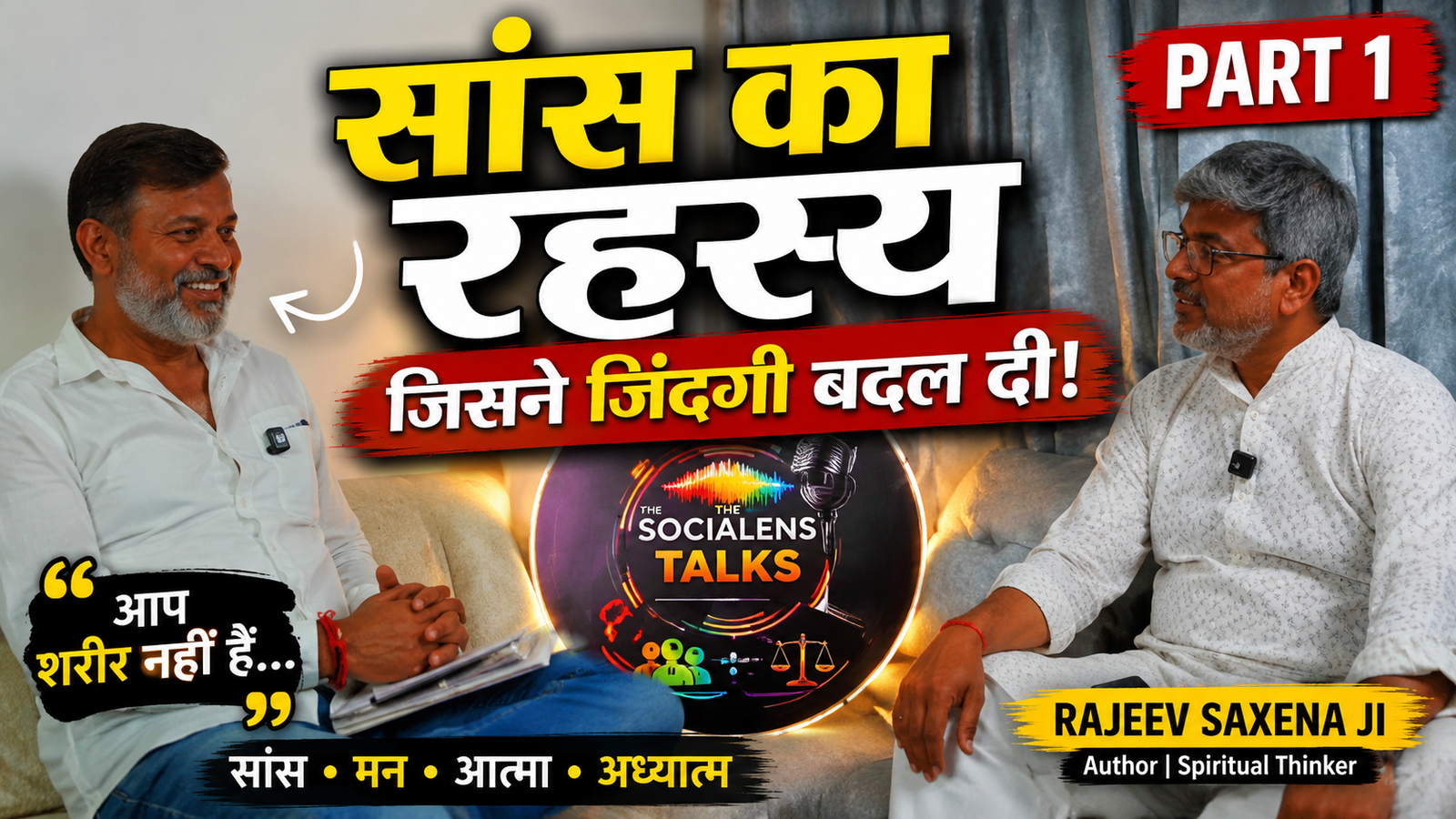
Rajiv Saxena Part 1: Breath, Awareness, Spirituality & Understanding Who We Really Are
We breathe every moment, yet most of us rarely stop to notice our breath.
What if something as ordinary as breathing could tell us something about our state of mind? What happens to our thoughts and emotions when our breathing changes? And if we begin looking deeper, can the journey of understanding the breath eventually lead us towards understanding ourselves?
These are some of the questions explored in this conversation with Rajiv Saxena, author of Saas Ke Rahasya Jo Chahe So Paaye.
The conversation begins with something that is always with us—the breath—and gradually moves towards the mind, the body, spirituality, self-awareness and the deeper question:
Who am I?
Note: This article is based on the conversation featured in The Socialens Talks episode with Rajiv Saxena. The spiritual and philosophical explanations discussed in the article represent perspectives expressed during the conversation and are not presented as scientific or medical conclusions.
Breath: Something We Do Without Thinking
One of the simplest observations in the conversation is also one of the most fundamental:
“Saas hai to hum hain, aur saans nahi hai to hum nahi hain.”
Rajiv Saxena points out that breathing is essential to life, yet it is something we generally perform without consciously thinking about it.
We consciously think before doing many things.
We decide.
We analyse.
We act.
But breathing continues automatically.
That makes the breath unusual: it is always present, yet it often remains outside our attention.
Why Do We Know So Little About Our Breath?
Rajiv Saxena explains that because breathing happens automatically, most people do not pay attention to it.
During the conversation, he asks the host to notice which nostril is carrying more airflow at that particular moment.
The answer is simply:
“I don’t know.”
That small experiment illustrates the central theme of the discussion.
Something is happening continuously inside us, but we may not actually be aware of it.
The Breath Changes With Our Activities
According to the perspective shared in the conversation, breathing is not completely static.
When we eat, sleep or perform different activities, the rhythm and speed of breathing can change.
Rajiv Saxena connects these changes with the way we experience different activities and emotional states.
The example of anger is particularly direct.
He explains that anger is associated with faster breathing and that changes in breathing accompany changes in emotional intensity.
On the other side, when a person is in a peaceful environment—a hill station or near the sea, for example—the breathing may become slower.
The conversation therefore presents an interesting relationship:
Breath ↔ Mental State
From Breath to Awareness
The discussion then goes beyond simply observing breathing.
Rajiv Saxena explains that different forms of spiritual practice are connected with breath, and he specifically refers to pranayama as the practice of working with the breath.
He also connects this with Ashtanga Yoga, referring to pranayama as the third component after yama and niyama.
The larger point of the conversation is that breath can become an object of conscious observation.
Something that normally happens automatically can become something we consciously notice.
What Is Spirituality Really About?
The host then asks Rajiv Saxena about spirituality and his own spiritual journey.
Instead of immediately giving a conventional definition, Rajiv Saxena turns the question around:
What is spirituality?
The conversation examines a common assumption that spirituality is simply associated with monks, saints, religious clothing or people living away from society.
Rajiv Saxena challenges that idea.
He explains that the external appearance of a person does not determine whether someone is spiritually realised.
This becomes one of the important themes of the conversation:
Spirituality is not necessarily about appearance.
Why Do Some Spiritual Traditions Use Specific Clothing?
The conversation then explores why certain spiritual traditions use particular colours or styles of clothing.
Rajiv Saxena explains that, from the perspective discussed in the episode, wearing a simple or consistent type of clothing can reduce the mind’s attachment to constantly choosing and worrying about appearance.
He describes this as part of gradually reducing attachment to the external physical world.
The discussion then takes an even deeper turn.
Clothing itself becomes an analogy for the layers through which we understand ourselves.
The Body as a Layer
Rajiv Saxena describes the physical body as the gross body and discusses the idea of subtle and causal bodies within a spiritual framework.
The conversation presents the subtle body as connected with the functioning of the mind and with the way inner processes influence outward actions.
This leads to a basic but powerful observation:
Our external actions often begin with something happening internally.
A question is first formed internally.
An intention arises.
A thought appears.
Then the body acts.
How Does the Mind Control Our Actions?
The conversation discusses the five sense organs and the five organs of action.
The eyes, nose, ears, mouth and skin are described as organs through which we receive sensory information.
Hands, feet and other organs involved in action allow us to respond to the world.
Rajiv Saxena explains that the mind plays a role in directing these processes.
He uses a simple everyday example:
The host moves his thumb.
The movement happens without him consciously planning it a moment beforehand.
This becomes an illustration for the discussion about processes occurring within us that we do not always consciously observe.
Action and Its Results
The conversation then moves from action to result.
Rajiv Saxena uses the example of eating food.
We eat something.
After that, a series of processes begins inside the body.
Different components are processed, nutrients are absorbed and waste is eventually removed.
The result of the action therefore continues even after the original action is over.
This example is used to discuss a broader idea:
Every action has consequences or results.
What Does “Adhyatma” Mean?
One of the central parts of the conversation is the distinction between spirituality and adhyatma.
Rajiv Saxena explains that the commonly used English word “spirituality” and the concept of adhyatma are not necessarily identical in meaning.
He breaks the word down in terms of the search for the self—understanding one’s real existence.
He gives a simple formulation:
Adhyatma means the study of oneself.
That definition changes the direction of the conversation.
Instead of asking only about God, religion or spiritual practices, we are asked to examine something much closer:
Ourselves.
Your Name Is Not You
Rajiv Saxena uses a very relatable example involving the host.
If someone asks:
“Who are you?”
the natural answer might be:
“I am Ashish Baniwal.”
But Rajiv Saxena points out that this is actually the person’s name.
The name could have been something else.
Parents chose it.
Therefore, the name identifies the person, but it does not necessarily answer the deeper question of who the person is.
The same reasoning is then applied to education.
Your qualifications describe something about you.
But they do not necessarily answer:
Who are you?
“My Body” and “My Self”
The conversation takes the question further.
We commonly say:
- My hand
- My leg
- My head
- My watch
- My glasses
Rajiv Saxena asks us to notice the language itself.
We say “my hand”, not “I hand.”
We say “my watch”, not “I watch.”
This distinction becomes an important part of the philosophical argument being discussed:
“I” and “mine” are not necessarily the same thing.
From there, the question moves inward.
If the body is “mine,” then:
Who am I?
Is the Mind Really the “I”?
Many people might answer:
“I am my mind.”
After all, our thoughts, emotions, likes, dislikes, happiness and sadness are experienced through the mind.
But Rajiv Saxena challenges this assumption too.
The conversation asks whether the person experiencing the thoughts and emotions is actually identical to the mind producing those experiences.
This becomes the central philosophical question of the episode.
The Dark Room Analogy
To explain how someone might approach the search for the self, Rajiv Saxena gives a powerful analogy.
Imagine you have kept something extremely important somewhere in a room.
The room is full of objects.
Then suddenly it becomes dark.
You need to find that important object.
What would you do?
Ideally, you would turn on a light.
Rajiv Saxena connects light with knowledge.
If there is no light, you have to search by touch.
You pick up one object and realise:
“This isn’t it.”
Then you put it aside.
You continue.
Eventually, by eliminating what the object is not, you move closer to what you are actually searching for.
The Search for the Real “I”
Rajiv Saxena applies this analogy to self-discovery.
If:
My body is not the deepest “I,”
and
my mind is not the deepest “I,”
then the question remains:
Who am I?
He connects this process with the spiritual idea of examining what we are not in order to understand what remains.
This is not presented as a quick answer.
Instead, it is described as a process of inquiry.
Ego and the Feeling of Separate Identity
The conversation then discusses the feeling:
“I am separate from you.”
Rajiv Saxena connects this sense of separate identity with ego within the philosophical framework he is explaining.
He then refers to the idea that the deeper self is connected with the Atma and Paramatma.
He also brings in a famous Kabir reference to explain the idea of searching within oneself.
The broader message is:
The search for the deepest self is an inward search.
Why Is Self-Discovery So Difficult?
If the answer is within us, why is it so difficult to discover?
This is where the conversation returns to the mind.
Rajiv Saxena describes the mind as extremely powerful and says that it does not allow us to remain in the present moment for even a moment.
Instead, it keeps moving.
Past experiences.
Future possibilities.
Thoughts.
Memories.
Plans.
Concerns.
The mind keeps us occupied.
The Mind Is Always Moving
The host shares a very relatable experience.
He explains that during prayer, even when his eyes are closed and he is repeating a chant, his mind may be somewhere else.
His mouth is saying one thing.
His mind is thinking about something completely different.
Rajiv Saxena uses this to demonstrate the constantly moving nature of the mind.
Almost everyone can recognise this experience.
You sit down to focus.
Within seconds, the mind is somewhere else.
What Is the Mind?
The conversation then asks a surprisingly difficult question:
Does the mind actually exist as a physical object?
Rajiv Saxena explains the mind using the concept of memory.
He describes it as a bundle or collection of memories.
This becomes one of the most interesting parts of the episode.
The “Doma Clomo” Experiment
Rajiv Saxena gives the host an imaginary word:
“Doma Clomo.”
Because the host has never heard the expression before, no familiar image or meaning immediately appears.
Then Rajiv Saxena says:
“Rose flower.”
Immediately, the host can imagine something.
Why?
Because the word rose already has an associated image and experience stored in memory.
The conversation uses this simple experiment to explain the idea that the mind works with previously stored information.
The Mind Stores Names and Images
Rajiv Saxena explains that, in the framework being discussed, the mind stores information both as:
- Names
- Visual images
When we see an image, the mind can associate a name with it.
When we hear a familiar name, the mind can produce an associated image.
The conversation uses this interaction between words, memories and images to explain how the mind operates.
What Happens When Memory Is Lost?
The discussion then considers a difficult but revealing example.
If a person’s memory is severely affected—for example, after an accident—what happens to their mind?
The conversation notes that such a person may fail to recognise people they previously knew, including family members.
Yet the person still exists.
This becomes part of Rajiv Saxena’s argument that the mind and the person are not necessarily identical.
The question becomes deeper:
If memories disappear, does the person disappear?
The conversation’s answer is no.
The Mind Can Only Go Where It Has a Reference
Rajiv Saxena then makes another interesting observation.
According to the explanation in the conversation, the mind generally moves towards things that are already registered in memory.
If you have a connection with a particular place, person or experience, your thoughts can quickly move there.
If you have no connection or stored reference for something, it is much less likely to spontaneously appear as a specific thought or image.
The conversation uses examples such as the United States and Hungary to illustrate this idea.
Where Is the Mind?
The host asks another basic question:
Where is the mind located?
Is it in the brain?
Is it in the heart?
People often associate emotions with the heart, while thoughts are commonly associated with the brain.
Rajiv Saxena points out that if the body were examined physically, we would not find an object called “mind” sitting inside the heart or brain.
He describes the mind instead as a non-physical flow associated with the brain, within the framework discussed in the conversation.
This brings the first part of the conversation to a natural stopping point.
The Central Questions of Rajiv Saxena Part 1
The episode ultimately revolves around a series of questions:
What is breath?
Something we continuously experience but rarely consciously observe.
What does breath have to do with the mind?
The conversation connects breathing patterns with mental and emotional states.
What is spirituality?
Rajiv Saxena describes adhyatma as the study or search for the real self.
Is the body the real “I”?
The conversation uses the distinction between “I” and “mine” to question this assumption.
Is the mind the real “I”?
The episode questions whether the experiencer of thoughts and emotions is identical to the mind.
What is the mind?
Rajiv Saxena explains it through the idea of stored memories and experiences.
Why is self-discovery difficult?
Because, according to the conversation, the mind continually distracts us and moves away from the present.
What Makes This Conversation Interesting?
The conversation does not remain limited to one subject.
It begins with breathing.
Then it moves to:
Breath → Mind → Body → Memory → Spirituality → Self → Consciousness
That progression makes the conversation particularly relevant for viewers interested in philosophy and spirituality, but also for anyone curious about how thoughts, memories and awareness shape everyday experience.
A Simple Reflection From the Conversation
There is an interesting exercise hidden inside the discussion.
The next time you sit quietly, notice:
Are you actually where your body is?
Or has your mind already moved somewhere else?
You may be sitting in your room, but thinking about tomorrow’s meeting.
You may be travelling somewhere, but thinking about yesterday.
You may be praying, but mentally planning your day.
The conversation suggests that observing this movement of the mind is itself an important part of becoming aware of how the mind works.
Who Should Watch This Episode?
This conversation may be useful for viewers interested in:
- Breath awareness
- Meditation
- Pranayama
- Spirituality
- Self-inquiry
- Mind and memory
- Consciousness
- Indian philosophical thought
- Personal reflection
- Understanding the relationship between thoughts and actions
It can also be interesting for anyone who enjoys conversations that begin with an everyday subject and gradually move towards deeper philosophical questions.
Watch the Full Rajiv Saxena Part 1 Conversation
Rajiv Saxena Part 1 — Breath, Awareness and the Search for the Real Self
Watch the complete conversation on YouTube:
https://www.youtube.com/watch?v=YJ_k5qTIPlg
Related Conversations on The Socialens Talks
Rajiv Saxena Part 2 — Mind, Memory & Inner Peace
Part 2 continues the discussion by exploring the evolution of the mind, memory, chitta, inner peace, breath, silence, success, manifestation and the journey within.
Episode:
https://thesocialensstalks.com/rajiv-saxena-mind-memory-inner-peace-spiritualit/
YouTube:
https://www.youtube.com/watch?v=5TQAp48_2qM
Kuldeep Singh Dharwal — Poetry, Creativity & Inner Reflection
Kuldeep Singh Dharwal’s conversation explores poetry, literature, language, creativity, spirituality and the relationship between social media and inner life.
Episode:
https://thesocialensstalks.com/kuldeep-singh-dharwal-podcast/
YouTube:
https://www.youtube.com/watch?v=x0rNdZuDbvI
Prof. H.C. Purohit — Education, Students & Personal Growth
Prof. H.C. Purohit discusses education, employability, student pressure, mentorship, emotional support and the changing needs of young people.
Episode:
https://thesocialensstalks.com/prof-hc-purohit-podcast/
YouTube:
https://www.youtube.com/watch?v=ba18t75T5lE
Frequently Asked Questions
Who is Rajiv Saxena?
Rajiv Saxena is the guest featured in this two-part conversation on The Socialens Talks. The episode discusses his book Saas Ke Rahasya Jo Chahe So Paaye and his perspectives on breath, mind, spirituality and self-understanding.
What is Rajiv Saxena Part 1 about?
Part 1 focuses primarily on breath, awareness, spirituality, the body, the mind, memory and the search for one’s real self.
What does Rajiv Saxena say about breath?
The conversation describes breath as fundamental to life and discusses how breathing patterns can change with different activities and emotional states.
What does Rajiv Saxena mean by Adhyatma?
In the conversation, Rajiv Saxena explains adhyatma as the search for or study of one’s real self—essentially, understanding who we truly are.
Is the body the real “I”?
The conversation questions this idea by distinguishing between “I” and “mine”—for example, “my hand” or “my watch.”
How does the episode explain the mind?
Rajiv Saxena explains the mind through the concept of stored memories and experiences and uses examples involving familiar words, images and memory loss.
Why does the mind keep wandering?
The conversation describes the mind as continuously moving through previously stored experiences, memories and associations. The host’s own example of trying to pray while his mind wanders illustrates this idea.
Is there a Part 2?
Yes. Rajiv Saxena Part 2 continues the discussion with deeper exploration of mind, memory, chitta, inner peace, breath, meditation, silence, success and spirituality.
Conclusion
Rajiv Saxena Part 1 begins with something as simple as breathing and gradually moves into much deeper questions about the mind, memory, spirituality, consciousness and the meaning of the self.
A recurring idea throughout the conversation is that many things happening within us remain unnoticed because our attention is constantly moving.
The discussion invites us to observe the breath, notice the movement of the mind and question assumptions about the body, identity and the meaning of “I”.
For viewers interested in breath awareness, spirituality, self-inquiry, meditation, consciousness and Indian philosophical thought, this conversation offers a different way of exploring these questions through a personal discussion.
This is what The Socialens Talks aims to document: real conversations, different perspectives and experiences that can be explored beyond the podcast itself.