
Real Conversations. Real People. Real Business Journeys.
What does it take to build a business that continues to earn customer trust for decades?
Is it branding? Is it technology? Is it capital? Or is it the quality of the product and the relationship a business builds with its customers?
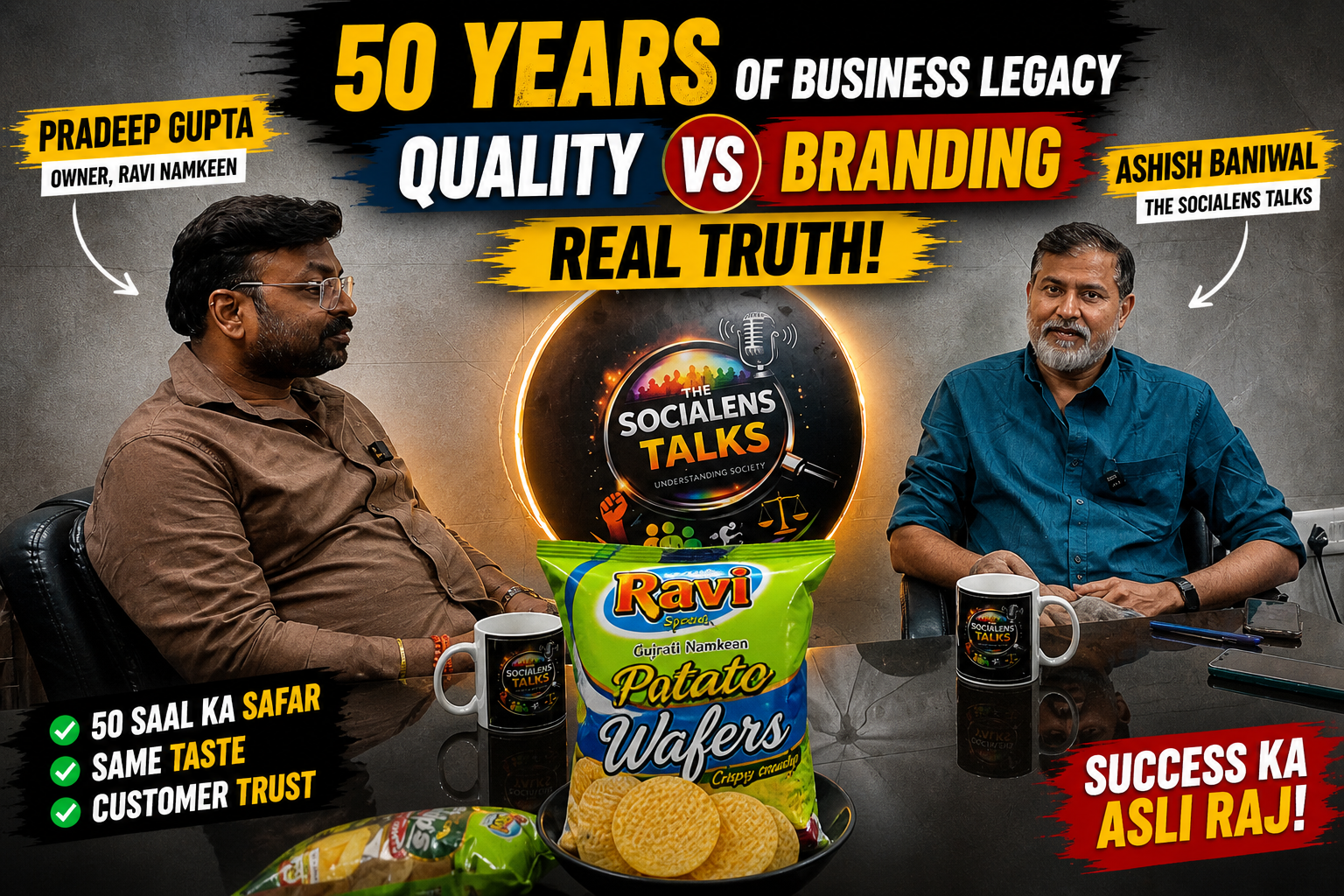
In this episode of The Socialens Talks, we spoke with Pradeep Gupta, whose business journey is closely connected with his family’s long-running snacks business, Ravi Namkeen.
The conversation takes us through his early years working alongside his father, the transition from manual production to machinery, maintaining the taste and quality of products, managing employees, understanding customers, handling competition, taking business risks and adapting to changing markets.
More importantly, Pradeep Gupta shares a practical perspective on what he believes keeps a traditional business relevant: quality, hard work, customer trust, knowledge of the business and the willingness to change when circumstances demand it.
A Family Business That Started About 50 Years Ago
Pradeep Gupta’s business journey began with his father.
According to him, his father started the business approximately 50 years ago, when it was still a small operation. The early business was built through hands-on work and direct selling, with his father personally visiting individual shops and selling the products.
Pradeep gradually joined his father while continuing his education.
He explains that he has now spent around 35 years working alongside his father, making the business journey a long-term family experience rather than simply a commercial venture.
For him, taking the business forward was also connected with a personal aspiration — to build on the foundation created by his father and take the work several steps further.
From Coal Furnaces to Machinery
One of the interesting parts of the conversation is how the business changed with technology.
In the earlier days, production was carried out manually using coal furnaces. Workers had to put coal into the furnaces during the day and remove it later.
As the business developed, Pradeep and his family gradually moved towards machinery and diesel-based furnaces.
This change increased production speed and helped the business serve a growing customer base.
The story illustrates an important aspect of traditional businesses: preserving the product does not necessarily mean keeping every production method unchanged.
The production process can evolve while the business continues to protect what customers value about the product.
Growth Without Losing the Original Taste
For Pradeep, one of the biggest challenges of business growth is maintaining consistency.
When asked how the business has maintained the same quality and taste over the years, he points towards the ingredients and preparation process.
He explains that the spices used in their products are prepared in their own factory. The spices are ground there, and he specifically says that their namkeen is handmade and that the same approach to quality has been maintained over the years.
This is an important part of his business philosophy:
Growth should not require compromising the product that created customer trust in the first place.
Quality Comes Before Branding
The conversation includes a direct question about product taste versus branding.
Pradeep Gupta’s response places the product itself at the centre.
According to him, the first requirement is that the product should have good taste. If the product does not satisfy customers, branding alone cannot sustain it in the market.
His reasoning is simple: a customer may purchase a product because of its branding, but whether they return depends heavily on the experience they had with the product.
For a food business, this means that branding can attract attention, but product experience is what can encourage repeat customers.
Customer Trust Is More Important Than Immediate Profit
When asked whether profit or customer trust matters more, Pradeep gives a clear answer:
Customer trust comes first.
He explains that once a customer has developed trust in a business, that customer is less likely to move away easily.
This idea appears repeatedly throughout his conversation.
For him, customer trust is not created through one advertisement or one interaction. It comes from maintaining:
- Product quality
- Taste
- Service
- Communication
- Consistency
- Customer relationships
That combination becomes part of the identity of a business.
Service Is Part of the Product Experience
Pradeep does not limit customer service to after-sales support.
He talks about the way customers are treated when they visit the shop and how the business presents its product and communicates with customers.
In his view, quality, product finishing, service and behaviour all contribute to how customers perceive a business.
This is particularly relevant for traditional businesses where direct customer relationships remain an important part of the business model.
Supporting the People Behind the Business
The conversation also moves from customers to employees.
Pradeep explains that many of the workers associated with the business come from places such as Uttar Pradesh, Bihar and Haryana. They leave their families to work.
Because of this, he says the business tries to stand with workers when they face family or financial difficulties.
He describes this relationship as one based on mutual support: when the business supports its workers, the workers also stand with the business.
For him, employees are not simply people performing tasks inside a factory.
The relationship involves responsibility, trust and mutual support.
Traditional Methods and Modern Techniques Can Coexist
One of the questions in the conversation asks whether traditional recipes and modern techniques have created a conflict.
Pradeep’s response is that the business has continued to retain its traditional approach to spices and preparation while adopting machinery where it improves the production process.
This creates an interesting distinction:
Technology can change how a business produces something without necessarily changing what customers value about it.
In the case discussed in this episode, machinery helped increase production, while the business continued to focus on its established taste and product quality.
If Starting From Zero Today, What Would He Do?
The interviewer asks Pradeep an important entrepreneurial question:
If you had to start the business from zero in 2026, what would you do to grow it significantly over the next few years?
His answer begins with people and knowledge.
According to Pradeep, the first requirement would be a capable team.
But before even building the team, he emphasises understanding the business itself. If someone wants to enter a particular field without knowing how that business works, he believes it becomes difficult to manage the operation effectively.
He outlines a basic sequence:
Knowledge → Skilled Team → Production Unit → Market
This reflects his belief that entrepreneurs should understand the complete process rather than depending entirely on other people for fundamental business knowledge.
A Business Owner Should Understand the Ground Level
Pradeep strongly supports hands-on involvement.
Even though the business has managers and staff handling different responsibilities, he explains that he still personally checks products, interacts with customers and remains involved with the market.
He says the business owners continue to check their products themselves and meet customers directly.
His philosophy is that a business owner should understand the work from start to finish.
If the owner does not understand the process, it becomes difficult to properly supervise or evaluate the work being done by others.
Competition Does Not Have to Distract a Business
Every growing business eventually faces competition.
Pradeep’s approach is interesting because he does not appear to make competition the central focus of his strategy.
He explains that when a business consistently produces a good-quality product, customers themselves begin associating that quality with the business name.
He also mentions that products can sometimes be copied, but his approach is to continue maintaining the quality rather than becoming overly concerned with competitors.
In other words:
Focus on your product and your customers instead of allowing competition to dictate every decision.
Hard Work Is a Habit, Not a One-Time Effort
When asked about a habit that contributes to success, Pradeep repeatedly answers:
Hard work.
For him, sustained effort is a basic requirement of business.
This becomes especially relevant when considered alongside his own journey — joining the family business at a young age, continuing to work through changing production methods and remaining involved in the business for decades.
Risk and Stability: Why Risk Matters
Pradeep also talks about risk.
When asked whether he would choose risk or stability, he says that taking risks is necessary for someone who wants to achieve success.
His view is that without taking calculated risks, meaningful progress can become difficult.
For an entrepreneur, this does not necessarily mean taking every possible risk.
Rather, his response reflects the idea that business growth requires a willingness to move beyond complete comfort and certainty.
Why an Early Start Can Make a Difference
Pradeep started becoming involved in the business seriously when he was around 17–18 years old.
At that time, he was still studying, but his father’s health problems led him to become increasingly involved in the business.
Eventually, his education gradually took a back seat as his responsibilities in the business increased.
His story therefore also reflects the realities that can exist within family businesses, where personal circumstances can influence education, career choices and professional responsibilities.
Online Business Is the Next Step
Although Ravi Namkeen’s business has traditionally operated through physical markets, Pradeep recognises that consumer behaviour is changing.
He explains that their products already reach markets across several regions, including Delhi, Haryana, Uttar Pradesh, Punjab, Himachal Pradesh, Uttarakhand and Rajasthan.
At the same time, he acknowledges that the business will eventually need to move towards online channels as the market changes.
His observation is straightforward:
Change is a part of business.
A traditional business can preserve its core identity while adopting new channels for reaching customers.
His Approach to Business Mistakes: Don’t Trust Blindly
One of the rapid-fire questions asks Pradeep about a business mistake that taught him something.
His answer is:
Blind trust.
He explains that when working with someone, a person should keep their eyes open rather than trusting blindly.
His point is not that trust should disappear from business relationships, but that business owners should remain aware of what is happening around them.
This is particularly relevant for growing businesses where multiple people, suppliers, employees, customers and partners may be involved.
Why He Prefers Starting Work Early
When asked whether starting early in the morning improves productivity, Pradeep says that he prefers beginning work early.
For him, starting the day early contributes to a productive working routine.
It is a small part of the conversation, but it fits with the broader pattern of his responses around discipline and consistent effort.
Honesty and Hard Work in Business
When asked about one quality every businessperson should have, Pradeep highlights:
Honesty and hard work towards the work they do.
These two qualities connect closely with his earlier comments about customer trust and product quality.
For him, business success is therefore not presented as being based only on marketing or financial investment.
It also depends on the way the entrepreneur approaches the work itself.
His Favourite Product and the Importance of Customer Preference
The conversation takes a lighter turn when Pradeep is asked about his favourite namkeen.
He chooses Punjabi Namkeen.
He explains that customers have different tastes — some prefer spicy flavours, some prefer sweet-and-sour combinations, while others may want less salt or less sweetness.
He shares an example of customers waiting for Punjabi Namkeen and even contacting the business from Punjab after tasting the product elsewhere.
For him, receiving such calls is a source of happiness because it shows that customers remember and actively seek the product.
This story brings the conversation back to the same theme: customer preference is ultimately demonstrated through customer behaviour.
Success, According to Pradeep Gupta
When asked to describe success in one word, Pradeep connects it with himself and his hard work.
His answers throughout the conversation suggest that he views success as something built over time through consistent effort rather than something that comes from a single shortcut.
His own journey — from working alongside his father to becoming deeply involved in the family business — provides the context for that view.
Family Remains at the Centre
Towards the end of the conversation, Pradeep is asked what he would wish for if he had three wishes.
His answers are closely connected to his family and business.
He wishes for his children to study and progress, for his family to remain free from major difficulties, and for the business he and his family work on day and night to continue growing.
This gives another dimension to his entrepreneurial journey.
For him, business is not completely separate from family. The two have developed together over generations.
If He Suddenly Received ₹10 Crore
Another lighter question asks what he would do if he woke up one morning and discovered that he had won ₹10 crore.
His first thoughts include a dream home, a larger business and family.
But he also talks about helping people who cannot afford education or who face difficulties in life.
He says that he would allocate a significant portion towards people who need such support before thinking about his family and business requirements.
This answer reflects another recurring theme in the conversation: the importance of family, work and helping others.
“We Make Namkeen, But We Also Make Happiness”
The conversation ends on a warm note.
Pradeep thanks The Socialens Talks for giving him an opportunity to share his journey and then gives viewers a simple message connected to his business.
He describes the business not only as making namkeen but also as creating happiness and relationships through the product.
It is an appropriate ending to a conversation centred around a business that has developed through family, customers, workers and decades of work.
Key Lessons From Pradeep Gupta’s Business Journey
Pradeep Gupta’s conversation offers several practical lessons for entrepreneurs and family-business owners:
1. Understand the business before trying to grow it
Knowledge of the actual process is essential before an entrepreneur can effectively manage others.
2. Don’t compromise the product for growth
For Pradeep, quality and taste remain central to the business identity.
3. Customer trust matters
He places customer trust ahead of immediate profit.
4. Technology can support traditional businesses
The transition from coal furnaces to machinery demonstrates how production can evolve without abandoning the product’s core identity.
5. Employees are part of the business ecosystem
Supporting workers during difficult circumstances can strengthen mutual trust.
6. Business owners should stay connected to the ground level
Pradeep continues to check products and interact with customers personally.
7. Change is unavoidable
His comments about online expansion show his recognition that traditional businesses also need to respond to changing markets.
8. Hard work remains fundamental
He identifies hard work as one of the habits behind success.
9. Risk is part of entrepreneurship
He believes progress requires a willingness to take risks.
10. Trust should not mean blind trust
His experience taught him to remain alert while working with others.
Who Should Watch This Conversation?
This episode may be particularly relevant for:
- Family-business owners
- Young entrepreneurs
- Small and traditional business owners
- Food-business entrepreneurs
- Students interested in entrepreneurship
- People considering taking over a family business
- Professionals interested in customer relationships
- Anyone interested in real business journeys
The conversation is especially useful because it does not present entrepreneurship only through theories. It comes from the experience of someone who has spent decades working within a family-run business.
Watch the Full Pradeep Gupta Conversation
Pradeep Gupta | Family Business, Quality, Customer Trust, Hard Work & Entrepreneurship
Watch the full Pradeep Gupta conversation on YouTube
Related Conversations on The Socialens Talks
Prof. H. C. Purohit
A conversation about student welfare, education, employability, skills, discipline, mental health and the changing needs of young people.
Read the Prof. H. C. Purohit conversation
Watch Prof. H. C. Purohit on YouTube
Kuldeep Singh Dharwal
A conversation exploring poetry, literature, creativity, spirituality, language and social media.
Read the Kuldeep Singh Dharwal conversation
Watch Kuldeep Singh Dharwal on YouTube
Vijay Bhatt
A conversation around environment, forests, water, urbanisation and the changing natural landscape of Uttarakhand.
Read the Vijay Bhatt conversation
Frequently Asked Questions
Who is Pradeep Gupta?
Pradeep Gupta is featured on The Socialens Talks discussing his long association with his family’s snacks business and his experience of building and managing the business over several decades.
How long has Pradeep Gupta’s family been in the snacks business?
According to the conversation, his father started the business approximately 50 years ago, and Pradeep says he has personally worked alongside his father for around 35 years.
What does Pradeep Gupta consider more important — branding or product quality?
He places strong emphasis on the product itself, explaining that branding cannot compensate for a product that does not deliver the expected taste and experience.
What does he consider important for business success?
He highlights hard work, honesty, product quality, customer trust, business knowledge and the willingness to take risks.
Does Ravi Namkeen currently sell online?
In the conversation, Pradeep explains that the business primarily operates through physical/local markets but acknowledges that moving towards online channels will become necessary as the market changes.
What is Pradeep Gupta’s approach to competition?
He says the business focuses on maintaining its own quality rather than becoming overly concerned about competitors.
What advice does he give to someone starting a new business?
His advice begins with understanding the business, learning the necessary knowledge, building a capable team, establishing the production setup and then developing the market.