
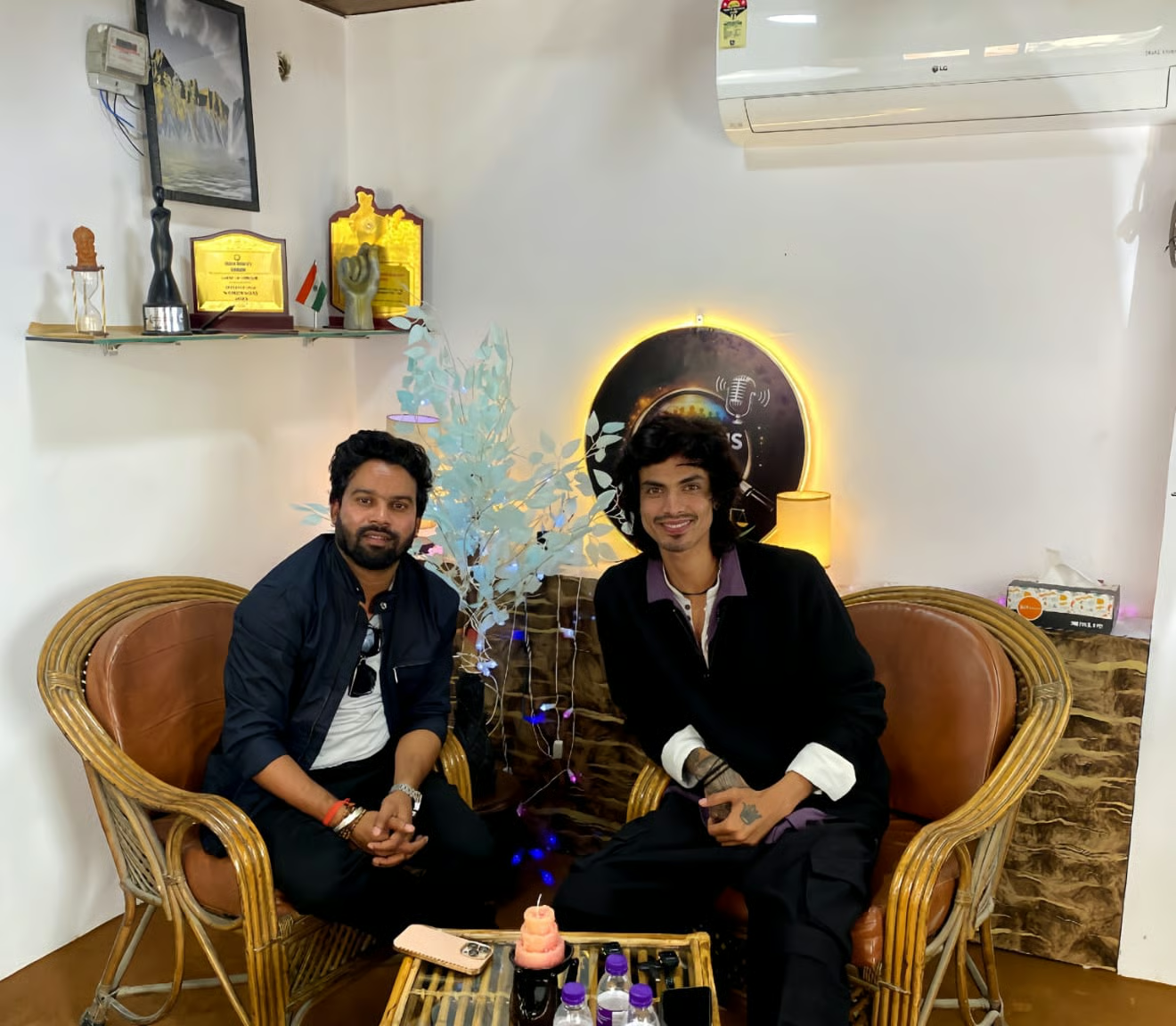
Sunny Dayal Podcast | Dancer से Singer बनने तक की कहानी, Struggle, Fame & Uttarakhand Music
From Background Dancer to Singer
Before becoming known for singing, Sunny Dayal was already working in the creative field as a dancer.
He explained that he worked as a background dancer and also participated in albums. At one point, he even had an interest in becoming an actor.
Alongside dancing, he also developed an interest in music and played instruments such as dholak and harmonium.
According to Sunny, singing eventually became part of his journey almost unexpectedly. He described his musical ability as something he considers a gift and connected his artistic background with his family as well.
His father was also connected with cultural activities in the village and was involved with Ramleela, which Sunny says contributed to the environment in which his interest in the arts developed.
So, before there was a singer, there was already a performer.
When the First Song Became a Hit
One of the most memorable parts of the conversation is Sunny’s story about his first studio-recorded song.
He explained that the first song he recorded in a studio was a love song, and unexpectedly, that very first song became popular.
The technology of the time was very different from today’s social-media environment.
This was the period when:
- cassette culture was already declining
- CDs were nearing the end of their popularity
- VCDs were becoming less relevant
- mobile memory cards were common
- people shared songs through Bluetooth
Sunny entered the singing space during this transition and received a positive response to his first song.
The response became especially meaningful when people began recognising his songs during stage performances.
He gradually realised that singing was becoming a part of his identity.
When a Fan Travels Just to See You
For any artist, audience recognition can be emotional.
Sunny shared an incident involving a listener from Dehradun who was travelling toward Purola for a show.
The person met Sunny along the way and told him that he had specifically come hoping to see him.
For Sunny, this was more meaningful than simply earning money.
The moment reminded him that his work had reached a real person strongly enough for that person to make a journey just to meet him.
That experience reflects an important difference between numbers and connection.
A view is a number.
A person travelling to meet you is an experience.
Performing in Front of Narendra Modi and Shinzo Abe
Sunny also recalled an important performance opportunity connected with the bullet train foundation ceremony.
He clarified that it was not a personal meeting with the leaders. Rather, he received an opportunity to perform in an event where Narendra Modi and Shinzo Abe were present.
He also recalled another performance in Dehradun in front of Modi, where several artists performed together.
For Sunny, the significance of the moment was simply that the country’s Prime Minister was present while they performed.
He described seeing the audience response and the performance atmosphere as a memorable experience.
Sunny Dayal Does Not Chase a Huge Target
When asked about his future plans, Sunny gave an unusually simple answer.
He said that he does not constantly think about becoming extremely rich or accumulating luxury items.
Instead, he focuses on the moment he is living in.
His perspective is that the present moment should be lived peacefully rather than constantly comparing one’s life with someone else’s achievements.
He also spoke about his faith and gratitude, saying that he considers his musical journey a result of blessings rather than believing that he knows everything about music.
This idea of contentment becomes one of the recurring themes of the conversation.
The Singers Sunny Dayal Looks Up To
During the discussion about music, Sunny mentioned several singers whose work he appreciates.
Among the names discussed were artists from Uttarakhand and the wider music industry.
He specifically spoke highly of Sonu Nigam and Jubin Nautiyal.
Sunny described Sonu Nigam with admiration for his singing ability and musical class.
When discussing Jubin Nautiyal, however, he focused particularly on humility.
According to Sunny, Jubin’s ability to remain grounded despite becoming a well-known singer is something other artists can learn from.
For Sunny, success is therefore not only about reaching a high position.
It is also about what happens to your behaviour after reaching it.
“रूह” और “Vibe” — Sunny Dayal on Changing Music
One of the most interesting discussions in the podcast is about how the language around music has changed.
Sunny observed that earlier people often talked about a song having “रूह”—a sense of soul, feeling and emotional depth.
Today, people often describe a song by saying:
“Isme vibe hai.”
He explained that earlier listeners were more likely to listen to an entire song and follow its story from beginning to end.
Today, according to his observation, a single catchy line can become the part that audiences repeatedly consume through short-form content.
But Sunny did not say that modern music is simply bad.
Instead, he acknowledged that artists have to adapt with changing times.
His personal view was that artists can create music that has the contemporary “vibe” while still retaining emotional depth.
That creates an interesting question for modern musicians:
Can a song be contemporary without losing its soul?
Uttarakhand Music and the Importance of “Maryada”
The conversation then moves into an important topic for regional artists: cultural identity.
Sunny repeatedly uses the word “maryada.”
For him, Uttarakhand’s music can evolve.
Artists can experiment.
Fusion can happen.
Modern sounds can be introduced.
But cultural identity should not disappear in the process.
He connects this idea with:
- language
- clothing
- local identity
- respect
- hospitality
- cultural values
- traditional expressions
His view is that modern music can still carry the identity of the region.
He also refers to older songs and artists whose work continues to help later generations understand the culture and environment of the mountains.
For Sunny, creating music that remains meaningful over time is more important than simply following a short-term trend.
Rap, Fusion and New Genres in Uttarakhand
The discussion also touches on rap and newer musical styles.
Sunny sees rap as another part of music, with its own audience.
He acknowledges that Uttarakhand is also seeing newer genres and experimentation.
His emphasis, however, remains on maintaining cultural boundaries while experimenting.
He suggests that artists do not necessarily need to abandon older cultural material to create something modern.
Instead, traditional words, stories and ideas can potentially be presented through newer musical arrangements.
That approach creates space for both:
tradition + experimentation.
The ₹2,000 That Helped Start a Song
Behind the music was a financial struggle that is easy to miss when looking at an artist’s later career.
Sunny explained that when he wanted to record his first song, he did not even have enough money for basic travel expenses.
He borrowed ₹2,000 from a friend to record the song.
He also had to balance other responsibilities, including:
- education
- college
- examinations
- living expenses
- travel
- family expectations
He described coming from a middle-class family and explained that creative careers can require time and financial investment before results become visible.
That ₹2,000 is therefore more than a number in his story.
It represents the uncertainty that can exist at the beginning of a creative career.
When Family Wants a Stable Job
Sunny also discussed the expectations he faced at home.
He had studied PCM in school, and like many families, his parents naturally thought about a stable career and employment.
At the same time, he had a strong desire to continue working in the creative field.
This created a practical challenge.
A person pursuing music may need:
- money to record
- time to practise
- opportunities to perform
- transportation
- equipment
- accommodation
- patience
while simultaneously completing education and meeting family expectations.
Sunny’s experience reflects the difficult period when passion exists but financial and practical resources are limited.
A Message to Young Singers
Sunny’s advice to new singers is closely connected to his own experience.
He points out that opportunities are more accessible today than when he started.
There are now:
- more studios
- more digital platforms
- social media
- YouTube
- performance opportunities
- talent-based platforms
He encourages young people to take their work seriously and give their best effort.
Most importantly, he says they should not give up simply because the journey becomes difficult.
His own story of borrowing money to record his first song becomes an example of how limited resources do not necessarily have to end a creative ambition.
Parents and Changing Attitudes Toward Creative Careers
Sunny also noticed a change in how parents look at creative careers.
Earlier, dancing and singing could sometimes be treated as hobbies rather than serious professions.
He remembers experiencing that kind of attitude himself.
But he also feels that many parents today are becoming more supportive.
He gave examples of parents who openly talk about their children pursuing acting and other creative fields.
Sunny believes that when a child genuinely wants to pursue a creative career, parental support can make a meaningful difference.
Social Media: Promotion or Negativity?
For Sunny, social media can be very useful when used correctly.
Platforms such as Instagram and YouTube allow artists to promote new songs quickly.
For example, when a new song is released, an artist can use social media to inform followers immediately.
At the same time, Sunny points out that social media can also be used negatively.
The difference depends on how the individual chooses to use and manage it.
That is an important distinction for artists:
social media is a tool; its impact depends on how the tool is used.
Live Singing vs Recorded Singing
Another interesting section of the podcast deals with live performance.
Sunny discusses the difference between a genuine live vocal performance and a recorded track being played behind a performance.
He points out that modern technology allows audio to be heavily edited and processed.
According to him, a singer’s ability to reproduce a similar vocal quality live reflects the amount of work they have put into developing their voice.
For Sunny, therefore, technology cannot completely replace the importance of an artist’s own preparation.
Don’t Judge a Song Only by Its Views
Sunny gives an interesting perspective on numbers.
He says that artists should not create music only while thinking:
“Kitne views aayenge?”
A song may not receive millions of views.
But if even a smaller number of people genuinely listen to it and connect with it, that still has value.
His advice to singers and writers is therefore to focus on creating something good rather than making views the only measure of success.
This is particularly relevant in an era where artists can become overly focused on:
- views
- likes
- shares
- followers
- trending audio
For Sunny, the quality of the work still matters.
Sunny’s Biggest Personal Struggle
When asked about the biggest struggle of his life, Sunny gave an interesting answer.
He said that becoming a dancer was relatively easy for him.
But becoming a good singer and a good human being was much harder.
He explained that after gaining recognition, an artist has to work on many things:
- appearance
- communication
- behaviour
- public interaction
- maintaining a professional image
- staying grounded
He also described the challenge of representing a relatively small regional background while wanting his work to be recognised across Garhwal, Kumaon and Himachal.
That makes his definition of struggle different from simply learning how to sing.
For him, the bigger challenge is also learning how to carry success.
Staying Grounded After Fame
Sunny openly acknowledged that people sometimes perceive artists differently after they become known.
He has heard people say that he is arrogant.
But he also points out that people who personally know him may have a different understanding of his personality.
His own description is that he remains connected to the ground and does not feel uncomfortable returning to a simple lifestyle.
He explained that he has travelled in ordinary vehicles and would not consider it a problem to do so again.
His message is straightforward:
Fame should not make you forget where you came from.
When You Feel Like Giving Up
Sunny admitted that there have been moments when he felt that perhaps he should stop.
Creative careers can create periods where results do not arrive as expected.
At such moments, he says there are essentially two choices:
- give up
- or become even more committed to the work
He emphasised persistence and giving one’s full effort.
For him, the people who continue listening and supporting the artist can themselves become a reason to keep creating.
A Funny Concert Moment
The podcast is not serious throughout.
Sunny also shared humorous experiences from concerts.
One incident involved a female audience member expressing her affection while he was performing.
He also talked about connecting with audiences during shows and enjoying moments when people participate enthusiastically.
These stories reveal another side of performing:
The relationship between an artist and a live audience can be spontaneous and unpredictable.
Marriage, Family and Living in the Present
The conversation also moved briefly into Sunny’s personal life.
He said he was not married at the time of the podcast and mentioned that his family had started asking him about marriage.
His response was that such things happen when the time is right.
He also described himself as the elder member of his family and acknowledged the responsibilities that come with that position.
Again, his response returned to the same philosophy:
Live the present while allowing life to develop naturally.
What’s Next for Sunny Dayal?
At the time of the podcast, Sunny had not released a new song for around seven months.
He explained that part of the delay was connected with family and household responsibilities, including work related to his house in the village.
He also pointed out that producing audio and video content requires money.
However, he said that several songs were already ready and that he was hoping to bring new music to audiences around Holi or shortly afterward.
This is another reminder that even established artists may have periods where new releases take time.
A Major Career Turning Point: Republic Day Performance
When asked about his biggest career turning point, Sunny mentioned a performance connected with a Republic Day tableau in Delhi.
He explained that a song he had sung was played during the tableau and that the performance received attention.
He described receiving congratulatory calls afterward and considered the experience a major achievement in his journey.
He also said that the tableau was a winner.
For Sunny, it was a moment that felt almost like a dream becoming real.
The Audience He Remembers
Sunny has performed in different places and described strong audience responses in places including Himachal and Purola.
He recalled one Purola performance where the crowd’s enthusiasm was particularly memorable.
At one point, his voice became tired, but the audience continued wanting him to stay on stage.
For a performer, these are the moments that turn a concert into a memory.
Love and the Story Behind His First Song
One of the most interesting personal revelations comes when Sunny is asked whether he has ever sung for someone he loved.
His answer connects directly to the beginning of his singing career.
He explained that his first song was dedicated to someone, and that song became popular.
According to Sunny, he entered singing through that experience almost without realising where it would eventually take him.
He also reflected on how relationships and ideas of love change with time.
He contrasted older forms of communication and loyalty with today’s much faster digital communication culture.
What Does Success Mean to Sunny Dayal?
For Sunny, success is not simply about becoming famous.
He makes an important distinction between achieving success and maintaining it.
Once an artist becomes successful, the challenge becomes:
- controlling ego
- maintaining behaviour
- staying respectful
- continuing to work
- remaining connected with people
He uses the traditional example of Ravana’s ego to explain the danger of arrogance.
According to Sunny, success can come relatively quickly, but maintaining it with humility is much harder.
He again refers to Jubin Nautiyal as an example of someone whose humility he admires.
Music as More Than Entertainment
Another important idea from the conversation is Sunny’s belief that music can have emotional value beyond entertainment.
He says that even a song with a small audience can matter if those listeners genuinely connect with it.
He also describes music as something that can provide comfort, comparing it to something that can become like a medicine when a person is unwell.
That idea connects directly with his earlier distinction between music with “vibe” and music with “rooh.”
For Sunny, emotional connection still matters.
What Young Artists Can Learn From Sunny Dayal
Sunny’s journey offers several practical lessons.
1. Your first role does not define your final destination
He began as a background dancer before becoming a singer.
2. Start with the opportunity available
His early work gave him practical exposure to the creative industry.
3. Financial limitations are real
His ₹2,000 borrowed for his first recording shows the financial uncertainty that can exist at the beginning of a creative career.
4. Keep learning
Sunny continues to describe himself as someone who is still learning.
5. Don’t measure every song only by views
A smaller audience can still represent genuine listeners.
6. Use social media intelligently
It can help artists reach audiences quickly, but its negative use can create problems.
7. Respect cultural identity
Modern music and regional identity do not necessarily have to be opposites.
8. Success requires humility
Getting recognition is one thing; maintaining the right attitude afterward is another.
9. Don’t give up during difficult periods
Sunny’s own journey includes moments when he considered stopping.
10. Make your family proud
His final message to young people repeatedly comes back to doing work that makes family and people around them feel proud.
Key Takeaways From the Sunny Dayal Podcast
- Sunny Dayal began his creative journey as a dancer.
- He worked as a background dancer and explored acting as well.
- Singing gradually became an important part of his career.
- His first studio-recorded song became popular.
- He entered singing during the transition from CDs to memory cards and Bluetooth sharing.
- He borrowed ₹2,000 from a friend to record his first song.
- He considers his musical ability a gift and credits his family and faith.
- He has performed at major public events.
- He discussed a performance opportunity where Narendra Modi and Shinzo Abe were present.
- He believes social media can be useful for promotion when used responsibly.
- He feels artists should not judge their work only through views.
- He discussed the changing language of music from “rooh” to “vibe.”
- He believes Uttarakhand music can modernise while retaining cultural identity and “maryada.”
- He considers staying grounded one of the most important parts of success.
- He believes maintaining success can be harder than achieving it.
- He continues to connect strongly with live audiences.
- His first song was connected with a personal love story.
- He encourages young artists to work honestly, stay patient and give their best.
Frequently Asked Questions
Who is Sunny Dayal?
Sunny Dayal is a singer and performer associated with Uttarakhand’s music scene. His journey also includes experience as a background dancer and performer.
Did Sunny Dayal start as a singer?
No. According to his podcast conversation, he first worked as a dancer and background dancer before moving more seriously into singing.
When did Sunny Dayal start singing?
The transcript indicates that he began singing around 2011–12, although the timestamp transcript contains some transcription ambiguity around the year.
Was Sunny Dayal’s first song successful?
Yes. He said the first song he recorded in a studio became popular.
How much money did Sunny Dayal borrow to record his first song?
He said he borrowed ₹2,000 from a friend because he did not have enough money for the recording.
What does Sunny Dayal think about social media?
He sees social media as useful for promotion and reaching audiences quickly, while also noting that negative use can create problems.
What does Sunny Dayal mean by “rooh” and “vibe”?
He uses the distinction to describe changing music culture. In his observation, older songs were often discussed in terms of emotional depth or “rooh,” while today’s audiences frequently use “vibe” to describe what they enjoy.
What does Sunny Dayal say about Uttarakhand music?
He supports experimentation and modernisation but emphasises retaining cultural identity, language, values and “maryada.”
What is Sunny Dayal’s message to young artists?
His message is to work honestly, give their best effort, remain patient, avoid giving up and create work that makes their family and community proud.
Related Conversations From The Socialens Talks
If you enjoyed the Sunny Dayal Podcast, you can also explore:
- Amit Nautiyal Podcast — music, creativity, youth and personal growth
- Anshul Negi Podcast — acting, dancing, viral reels and Uttarakhand youth
- Prince Divas Dabral Podcast — dance, passion, struggle and social media
- Luchacha Veer Podcast — village life, content creation and social-media reality
- Prof. H. C. Purohit Podcast — education, youth, skills and student development
- Sahil Diwan Podcast — childhood, parenting, technology and screen time
Watch the Full Sunny Dayal Podcast
The complete conversation is available on YouTube.
Watch Sunny Dayal Podcast Episode
You can also explore more conversations on The Socialens Talks YouTube Channel.
The episode is listed on the site’s Episodes directory as Sunny Dayal | Dancer से Singer बनने तक की कहानी, पहला गाना ही हुआ Hit | EP 02.
Conclusion
The Sunny Dayal Podcast is ultimately a conversation about much more than music.
It is about the journey from being a background dancer to finding an identity as a singer.
It is about recording a first song with borrowed money.
It is about performing before large audiences.
It is about experiencing recognition from people who travel just to see an artist.
It is about adapting to social media without allowing numbers to define the entire value of music.
And it is about trying to preserve cultural identity while participating in a rapidly changing music industry.
Sunny’s perspective on “rooh” and “vibe”, his emphasis on Uttarakhand’s maryada, and his repeated focus on remaining grounded after success give this conversation a clear identity.
Perhaps the most important idea running through the conversation is simple:
Success can bring recognition, but staying grounded determines how you carry that recognition.
And for Sunny Dayal, music remains connected not only with fame, but also with people, culture, memories and the journey that came before the spotlight.