
Real Conversations. Real People. Real Insights.
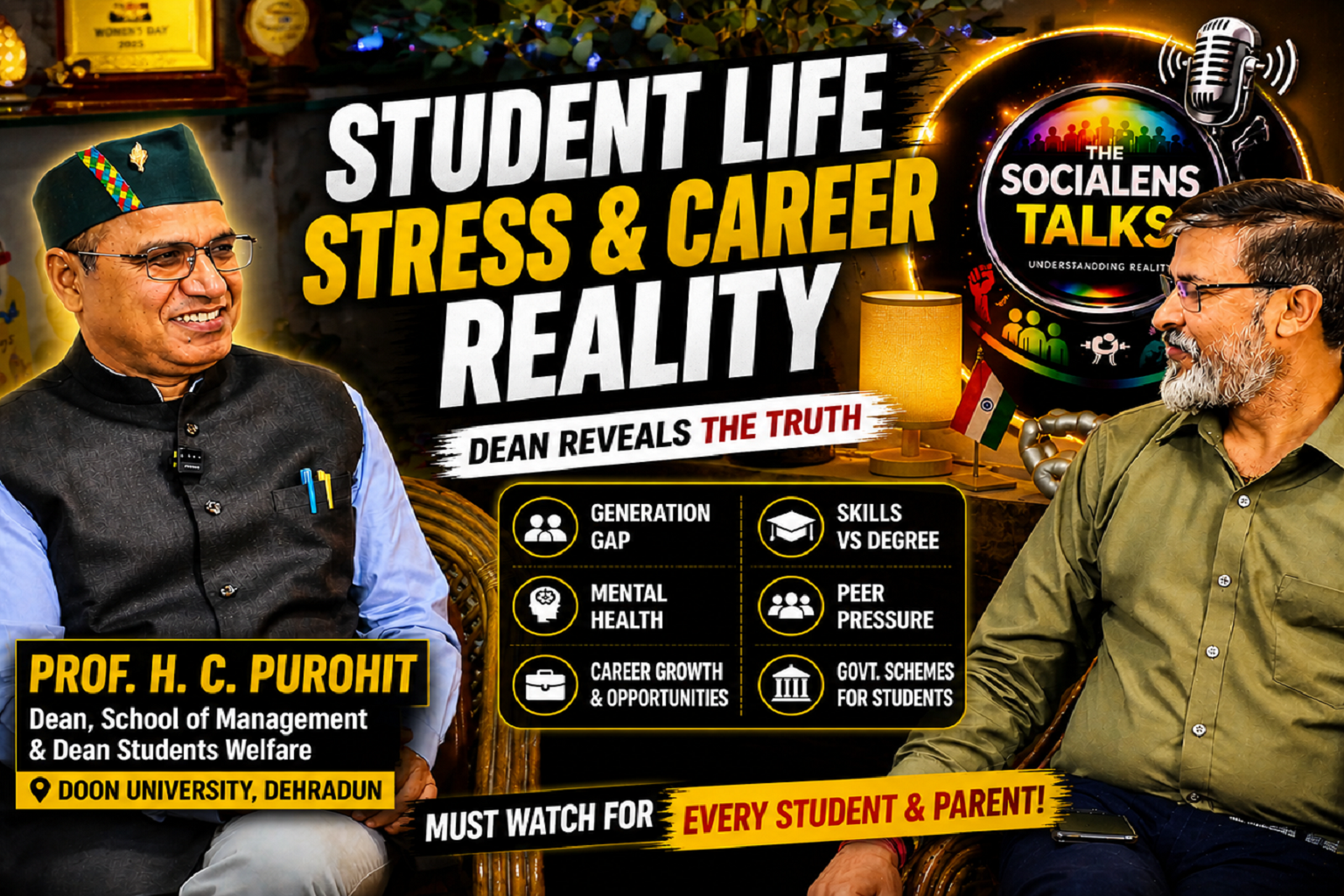
In this conversation on The Socialens Talks, we speak with Prof. H. C. Purohit about the changing realities of student life and the challenges young people face while preparing for education, careers and life beyond university.
The discussion covers student welfare, mental well-being, peer pressure, education, employability, practical exposure, technical and soft skills, mentorship, social media, inclusion, discipline, entrepreneurship and the changing relationship between students, parents and teachers.
Rather than looking at education only through examination results or academic qualifications, the conversation explores what students need to develop as individuals and how educational institutions can help prepare them for changing professional and social environments.
Understanding Student Welfare Beyond Academics
Prof. Purohit explains that student welfare is not limited to classroom teaching or academic performance.
From his perspective, students need opportunities to participate in sports, cultural activities, debates, quizzes, creative activities and other experiences that contribute to their overall development.
He also discusses the importance of connecting students with parents and alumni. Alumni can provide valuable feedback about the transition from education to professional life and can help institutions understand where students may need additional preparation.
For Prof. Purohit, education should support the holistic development of students, including:
- Academic learning
- Sports
- Cultural activities
- Creativity
- Communication
- Curiosity
- Emotional development
- Practical exposure
- Social responsibility
The broader idea is that a university should provide an environment where students can discover their interests and develop beyond lectures and examinations.
Peer Pressure, Expectations and Communication
Peer pressure is one of the important subjects discussed during the conversation.
Students can experience pressure from different directions, including friends, parents, teachers and society. Prof. Purohit distinguishes between positive and negative influences and highlights communication as an important part of helping students deal with pressure.
When students experience excessive stress, communication gaps can make the situation more difficult.
He therefore highlights the importance of stronger communication between:
- Students
- Parents
- Teachers
- Educational institutions
The conversation also touches upon counselling and psychological support, while emphasising the need to help students develop the emotional strength required to deal with environments beyond home and college.
From Classroom to Workplace: Why Practical Exposure Matters
Academic knowledge is only one part of preparing students for professional life.
Prof. Purohit discusses the transition from classrooms to workplaces and explains that professional environments have their own expectations, culture and working methods.
He therefore emphasises the value of:
- Practical exposure
- Internships
- Professional training
- Workplace awareness
- Adaptability
Students may perform well academically but still need exposure to real professional situations.
Education and training, according to the discussion, should therefore help students understand and adapt to changing environments.
Is a Degree Enough?
One of the important questions raised during the conversation is whether a degree alone is enough to prepare a student for professional life.
Prof. Purohit explains that a degree remains important, but students also need skills that allow them to apply their education effectively.
He distinguishes between technical skills and soft skills.
Technical skills help a person perform in a particular field, while soft skills influence communication, behaviour and the ability to work effectively with others.
A useful way of understanding this idea from the conversation is:
Degree + Technical Skills + Soft Skills
This combination can help students prepare more effectively for professional environments.
Education, Employability and Career Preparation
The conversation connects education directly with employability.
When students graduate without the skills expected in professional environments, the gap between qualification and workplace expectations can become challenging.
Prof. Purohit therefore discusses the importance of developing relevant skills during education rather than waiting until after graduation.
Practical exposure, professional training and workplace understanding can all contribute to this preparation.
Students as Job Seekers and Job Creators
Career planning does not necessarily have to follow only the traditional employment route.
The conversation also explores entrepreneurship and self-employment.
Prof. Purohit discusses the opportunities available to young people through startups, entrepreneurship and other forms of self-employment.
For students, this expands the idea of career planning beyond simply searching for a job after graduation.
Scholarships and Support for Students
Financial circumstances can sometimes become a challenge for students pursuing higher education.
During the conversation, Prof. Purohit discusses student-support mechanisms and examples of scholarship or assistance programmes, including:
- Chief Minister Higher Education Promotion Scholarship
- Doon University Students’ Aid Fund
- Pandit Mahanand Dangwal scholarship/fellowship
- Professor Gajendra Singh All-Round Student Award
He also explains that information about such opportunities can be communicated through university websites, departments and notices.
Note: Students should verify current eligibility, application dates and availability directly through the relevant official institution or scheme source before applying.
Mental Health and Student Welfare
Mental well-being is another significant part of the discussion.
Prof. Purohit connects academic pressure, expectations, employability, peer groups and communication with students’ overall psychological well-being.
He discusses psychological support mechanisms within the university environment and refers to a “Happiness Cell”, through which psychological professionals can support students.
The conversation also highlights the importance of approaching support sensitively so that students do not feel labelled for seeking help.
The Role of Mentorship
One of the more personal parts of the conversation concerns mentorship.
Prof. Purohit recalls a former student who met him in Delhi and remembered being told around two decades earlier that he could become a professor. That student eventually became a professor.
For Prof. Purohit, experiences like this demonstrate the potential influence of mentorship.
A mentor can sometimes help a student recognise possibilities that the student may not yet see for themselves.
This makes mentorship more than academic guidance; it can also involve encouragement, confidence and helping young people think beyond their existing limitations.
Rural and Urban Students: Different Exposure, Equal Potential
The conversation also considers differences between rural and urban students.
Prof. Purohit observes that students from rural backgrounds may initially experience challenges related to exposure or communication.
However, he does not connect talent with geography.
One of the important ideas from this part of the discussion is:
Exposure may differ, but talent and hard work are not restricted by location.
Students from different backgrounds may require different kinds of support and exposure, which is why understanding the individual student’s circumstances is important.
Gender Equality, Safety and Inclusion on Campus
The conversation also addresses gender equality and campus safety.
Prof. Purohit discusses several mechanisms associated with a university environment, including:
- Gender sensitisation programmes
- Internal Complaints Committee
- Equal Opportunity Cell
- Anti-Ragging Cell
- Disciplinary mechanisms
- Orientation programmes
- Hostel-related systems
He also discusses the importance of creating an educational environment where students receive equal opportunities irrespective of their background.
What Does Inclusive Education Mean?
For Prof. Purohit, inclusion is closely connected with equal opportunity.
Students may come from different geographical, economic or social backgrounds, but once they become part of an educational institution, they should have access to educational opportunities without being treated differently because of their background.
This connects inclusion directly with student welfare and institutional responsibility.
Social Media: Use It Without Losing Focus
The conversation takes a balanced approach to social media.
Prof. Purohit does not describe social media itself as inherently harmful. Instead, he distinguishes between using social media as a resource and becoming excessively involved in it.
Students can use social platforms to access information, communicate and stay aware of developments.
The concern arises when excessive time is spent checking:
- Likes
- Comments
- Shares
- Reactions
- Online debates
His practical message is to take useful information from social media while avoiding unnecessary involvement that takes attention away from important responsibilities.
Understanding the Changing Generation
Another major theme is the generation gap.
Today’s students grow up in an environment shaped by technology, digital information and rapidly changing career possibilities.
Prof. Purohit’s discussion suggests that parents and educators should understand the environment in which young people are growing rather than simply comparing them with previous generations.
Understanding the psychological and social environment of today’s students can help adults communicate with them more effectively.
More Information Does Not Always Mean More Direction
Today’s students have access to an enormous amount of information through technology, digital resources, libraries and online sources.
But access to information does not automatically provide direction.
The conversation highlights a different challenge: when young people have too many choices without adequate guidance, those choices can sometimes create confusion.
The discussion therefore emphasises the importance of appropriate guidance and positive direction, not simply access to more information.
Failure and Rejection as Part of Learning
Failure is another important theme.
Prof. Purohit encourages students not to treat one unsuccessful attempt as the end of their journey.
If one approach does not work, another possibility may exist.
The conversation presents failure as an opportunity for learning and connects this idea with skill development and confidence.
Students can continue developing by learning from setbacks rather than treating them as a final outcome.
Emotional Strength and Adaptability
The discussion identifies several strengths associated with today’s students, including:
- Technology awareness
- Communication
- Adaptability
- Career awareness
- Ambition
- Technical capability
At the same time, Prof. Purohit observes that students may struggle when they experience failure or rejection.
This makes emotional strength an important part of preparing young people for an environment where outcomes do not always go according to plan.
The Water Analogy for Adaptability
One memorable idea from the conversation is the comparison between adaptability and water.
Prof. Purohit uses water as an analogy for accepting and adapting to changing circumstances.
The underlying idea is that people cannot always control their environment. They can, however, develop the ability to understand situations, adjust and continue moving forward.
This connects with the larger discussion about preparing students for real-world environments.
Discipline and Freedom
The conversation also explores the relationship between discipline and freedom.
Prof. Purohit explains that discipline and freedom do not necessarily have to be opposites.
Using everyday examples such as traffic management and railway crossings, he explains that rules can create an environment in which people can move safely and effectively.
He summarises the idea through this principle:
Discipline creates the structure within which meaningful freedom can operate.
The same concept can be applied to student life through punctuality, routine and responsibility.
Theory and Practical Learning Need Balance
The conversation does not suggest replacing theoretical education with practical education.
Instead, Prof. Purohit discusses balance.
Theory is important for understanding concepts, while practical learning helps students apply those concepts.
Internships, workplace exposure and professional training can complement classroom learning and help students understand how knowledge is used outside an academic environment.
Education and Women’s Empowerment
The conversation also touches upon women’s education and empowerment.
Prof. Purohit discusses education as an important part of empowerment and emphasises the importance of continuing educational opportunities for girls.
The discussion connects women’s education with broader social development.
Procrastination and Student Life
Towards the later part of the conversation, procrastination is identified as a habit students should be conscious of.
Easy access to information and technology can sometimes create the feeling that a task can always be completed later.
But repeatedly postponing work can reduce learning opportunities and waste time.
The practical message discussed is simple:
If something needs to be done today, do not automatically shift it to tomorrow.
What Does Success Mean?
The conversation also explores the meaning of success.
Prof. Purohit does not restrict success to position, income or achievement.
He connects success with satisfaction and with the meaningful use of what a person has learned, particularly when that learning can contribute to society or help others.
This presents success as something that can involve both personal fulfilment and meaningful contribution.
Key Takeaways from the Conversation
The discussion with Prof. H. C. Purohit highlights several practical ideas:
- Student welfare extends beyond academic performance.
- Communication between students, parents and teachers is important.
- Mentorship can influence a student’s direction.
- Degrees are strengthened by technical and soft skills.
- Practical exposure can help students understand professional environments.
- Failure can become part of the learning process.
- Social media can be useful when used purposefully.
- Students need adaptability as circumstances change.
- Inclusion involves equal opportunity.
- Discipline can provide structure for responsible freedom.
- Education benefits from a balance between theory and practice.
- Success can involve satisfaction and meaningful contribution.
Watch the Full Conversation
Prof. H. C. Purohit | Student Welfare, Education, Mental Health, Skills & Youth
 Watch the full conversation on YouTube:
https://www.youtube.com/watch?v=ba18t75T5lE
Related Conversations on The Socialens Talks
Kuldeep Singh Dharwal — Poetry, Literature and Creativity
A conversation exploring poetry, literature, language, spirituality, creativity and the influence of social media.
Read the conversation:
https://thesocialenstalks.com/kuldeep-singh-dharwal-podcast/
Watch on YouTube:
https://www.youtube.com/watch?v=x0rNdZuDbvI
Priya Gulati — Journalism, Women Empowerment and Social Change
A conversation covering journalism, women’s empowerment, social responsibility, social work and personal resilience.
Read the conversation:
https://thesocialenstalks.com/priya-gulati-podcast/
Watch on YouTube:
https://www.youtube.com/watch?v=yqb-NOmPGnc
Vijay Bhatt — Environment and Uttarakhand
A conversation about environment, forests, water, urbanisation and the changing natural landscape of Uttarakhand.
Read the conversation:
https://thesocialenstalks.com/vijay-bhatt-podcast/
Watch on YouTube:
https://www.youtube.com/watch?v=FpxSarf0VlY
Frequently Asked Questions
Who is Prof. H. C. Purohit?
In this conversation, Prof. Purohit introduces himself as an Acharya at the School of Management at Doon University and discusses student welfare, education and related issues.
What are the main topics discussed?
The conversation covers student welfare, mental well-being, peer pressure, education, employability, practical exposure, skills, social media, inclusion, discipline, mentorship and the changing needs of young people.
Is a degree enough for professional life?
The discussion emphasises that a degree is important but should be supported by relevant technical and soft skills.
What does Prof. Purohit say about social media?
He discusses using social media as a source of information while avoiding excessive involvement in reactions, comments and endless online engagement.
What is the message about failure?
The conversation presents failure as something students can learn from rather than automatically treating one unsuccessful attempt as the end of their journey.
What is the importance of adaptability?
Adaptability is presented as an important ability because students will encounter changing environments in education, careers and everyday life.
What does the conversation say about success?
Prof. Purohit connects success with satisfaction and with using one’s learning meaningfully for society or to support others.
Conclusion
The conversation with Prof. H. C. Purohit brings together many aspects of modern student life — from academic learning and career preparation to mental well-being, mentorship, social media, inclusion and personal responsibility.
One of the strongest themes running through the discussion is that education is not limited to obtaining a qualification. Students also need skills, exposure, guidance, adaptability and the confidence to continue learning when circumstances change.
For parents, teachers, educators, students and young professionals, the conversation offers a broad look at the relationship between education and the realities students encounter beyond the classroom.
This is what The Socialens Talks aims to document: real conversations, different perspectives and experiences that can be explored beyond the podcast itself.